
[ad_1]
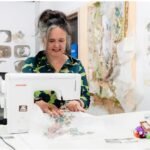
Anne Desmet, or, to use her recently bestowed title of the ‘British Escher’, is no stranger to Ulverston nor to the temperamental weather of Cumbria.
However, she can be forgiven for retreating to her studio after her shortest ever residency – four bracing October days spent outdoors in preparation for her role as Printmaker of the Year at Printfest, returning to Ulverston this early May bank holiday.
‘It was too cold to stand and draw, but I took a lot of photographs,’ she says.

An odd time to visit perhaps, for an artist who, by her own admission, pays the closest attention to how light reveals form, building images by carving light rather than shadow. But, October was the earliest opportunity for Anne to visit, following recovery from knee surgery.
Well, perhaps not quite the earliest opportunity.
‘They’d asked me to be Printmaker of the Year three years ago. Unfortunately, the email went into my spam. I didn’t see it for ages. I’m much more careful checking my spam these days,’ says Anne.
By the time she replied, there was no time to take up the residency, much to her regret, making this year’s invitation to take up the coveted role all the more delightful.

A long-established celebration of printmaking held annually in Ulverston, each year a Printmaker of the Year is invited to respond to the landscape through a residency, creating new work inspired by the local area.
Anne’s relationship with Ulverston is not new. Childhood visits from Liverpool, time spent staying with a friend in the Lake District and a visit to one of the first Printfests to support a fellow artist have all contributed to a long-standing connection to the area.
‘I’ve watched Printfest with interest over the years so it’s really lovely to be involved in it this year.’
Light, she explains, is what animates everything she saw during the residency.

‘There were a lot of very dramatic skies, beautiful shafts of sunlight in quite thundery skies making moody shadows. As soon as sunlight hits something, whether it’s a building or a tree or a hillside, you suddenly get this strong sense of its three-dimensionality and its structure. It brings the whole scene to life.’ That sensitivity to form has long underpinned her architectural work, but in Ulverston it found a refreshed expression in the landscape.
Wood engraving, she says, demands the same way of seeing. What is cut away becomes light; what remains becomes shadow.
‘With wood engraving, you have to think in light,’ she explains, a process she describes, with humour, as ‘the most sophisticated form of potato cutting’. Like drawing white chalk on black paper, it is the illumination itself that is carved. ‘I’m carving that light on my blocks.’
So, is this one of her favourite parts in the process?
‘Oh absolutely. I love engraving. I mean, some of this is due to my own physical limitations,’ Anne replies, before explaining that she was born with a hip disability which has caused ongoing difficulties and, most recently, led to the knee replacement which delayed her Ulverston residency.
The physical realities of her body have inevitably shaped her practice. Engraving, with its long, concentrated periods of seated work, suits her far better than the more physically demanding aspects of printing, requiring prolonged standing.
She enjoys printing, she says, but it is engraving – quiet, absorbed and precise – that she loves. She is working on 10 brand new engravings specially for Printfest, all inspired by the light and landscape of Cumbria. This attention to detail and light was forged early, in conditions that were imposed upon her from childhood.
Born in Liverpool in 1964, Anne spent much of her childhood in and out of hospital following repeated surgeries on her hip.
Long periods of enforced stillness became formative, shaping both her way of working and her way of seeing.

Confined to bed for weeks at a time, she began to draw obsessively on a small scale, the objects within reach on her locker, the reflection of a lightbulb, her own hands and feet – returning to the same subjects with patience and precision.
With hours to fill and little physical freedom, drawing became a way of attending closely to the world immediately around her. Alongside this early discipline of close looking came a fascination with transformation.
As a youngster, Anne was drawn to Ovid’s Metamorphoses, stories of bodies becoming birds, trees or rivers, a classical framework in no small way resonating with her own experience of physical limitation and change.
The idea that form could shift, adapt or become something else stayed with her, later finding expression in work concerned with architecture, structure and the traces of human presence over time. In fact, it was perhaps a random hashtag of the term metamorphosis thrown out on one of her Instagram posts that has resulted in a most extraordinary and unexpected connection to one of Anne’s all-time greatest influences.
‘I received a direct message from a curator of the Escher in The Palace Museum in Den Haag, that said they’d seen my work and they’d be interested in discussing the possibility of a solo show.

‘It was one of those messages that at first, I thought, that’s got to be a scam…’
The curator travelled to London to meet with Anne and to see her Guildhall Art Gallery exhibition in 2024 and the rest, as they say, is history.
Escher, whose work had been a formative influence since her teens, had long occupied the same imaginative territory of shifting perspectives, impossible spaces and images caught mid-transformation. But Escher as a printmaker?
‘I never really thought about him being a printmaker. In my teens, they were just great images. But actually, as a woodcut artist, wood engraver and lithographer, he’s absolutely stupendous.’
For the four-month-long exhibition, which ended in March, the museum was entirely rehung with Anne’s work placed in dialogue with Escher’s. Across a dozen rooms, themes emerged organically: night-time Italian scenes, portrait studies, transformations and impossible spaces. Some of the connections were immediately legible, others were more uncanny, pairing her work with Escher prints she had never seen before, yet which appeared to show a shared way of constructing images.

Alongside the exhibition, her latest book Wood Engraving: A Personal Approach, has recently been published by The Crowood Press. In the Netherlands, she has been affectionately dubbed the ‘British Escher’, a description she accepts with delight rather than discomfort. ‘It feels like a dream I didn’t know I had coming true,’ Anne admits.
The most moving moment came at the private view, where a small portrait of her own father was hung alongside Escher’s profile of his: ‘I was practically in tears.’
This considerate act of curatorship offers the perfect lens to Printfest 2026, where empathy forms the festival’s guiding theme.
Visit: printfest.uk
[ad_2]
Source link