[ad_1]
It was a bleak winter’s day in East London in January 2020, but for Dartmouth printmaker Stewart Taylor, it was the day that has shaped the way he prints, thinks, and works ever since.
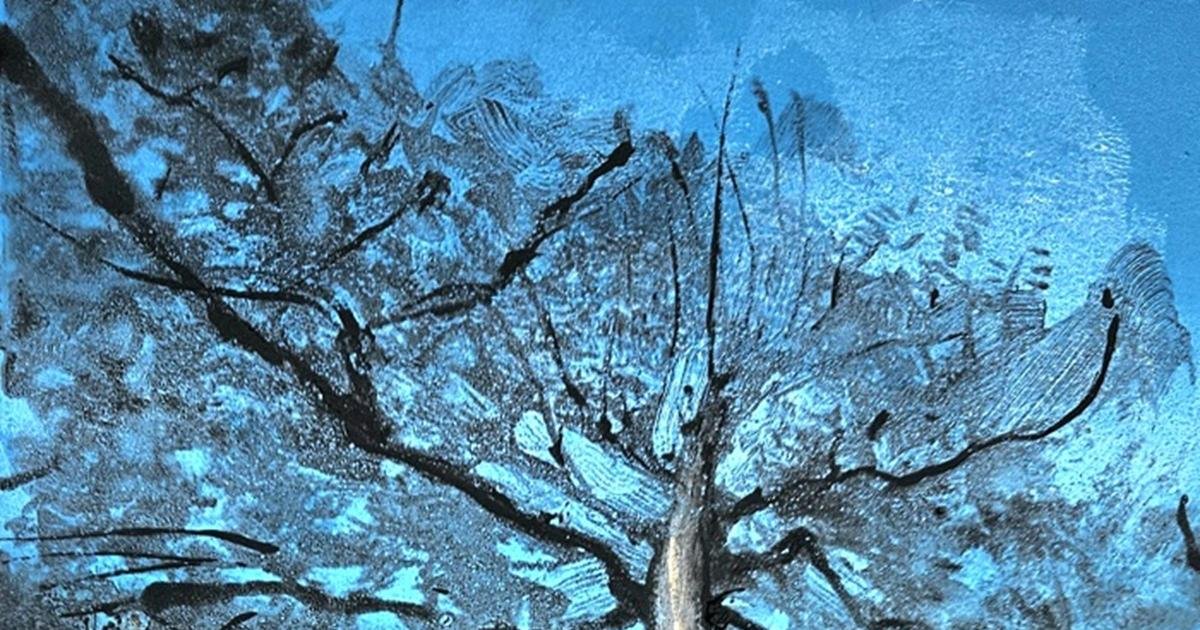
Outside his old flat in Newham, tree surgeons were pollarding the lime trees, leaving a sorry line of stumps all the way down the street. Struck by their stark silhouettes, Stewart created a monoprint of the one directly opposite his bedroom window. He then went out and took photos of all the stumps on the street and started making monoprints of them. He originally thought it was going to be a one-off session, but he says: ‘The combination of their forms and monoprint had me hooked.’ Six years on, he’s approaching his 500th tree portrait.
What began as a response to the pollarded street trees has, says Stewart, ‘grown into an exploration of ecology, resilience and memory’ – an exploration that’s brought him to the ancient woodland and temperate rainforests of Dartmoor.
While the first 150 or so of his tree portraits were of the London limes, his most recent ones are of the trees in Bovey Valley Woods and Lustleigh Cleave.

Stewart, who moved to Dartmouth in 2020, has also produced stunning prints of the much-loved Monterey pines near the South West Coast Path in Little Dartmouth and Brownstone, and created commissioned prints of trees in other parts of the world.
But it’s Dartmoor’s temperate rainforests that keep drawing him back: ‘The trees in Bovey Valley Woods are some of the rarest species we have, both here and globally,’ he explains. ‘Only one per cent of the UK’s landmass is temperate rainforest, and it used to be around 15 per cent. But the forest at Lustleigh is very young, it’s only been there for about 100 years. It used to be common land, but when the grazing stopped, the temperate rainforest grew, and that gives you cause for hope.’
Stewart has always felt connected to nature. When he’s not in his purpose-built wooden studio at the top of his garden, he’s helping to rewild a plot of land in Dartmouth. He’s also an amateur lepidopterist (studier of butterflies) and has donated his time and art for rewilding charities: ‘I once went to the big rewilding project in Sussex during the record butterfly emergence of purple emperors in 2018. Experts had just recorded over 300 in one day and I saw around 100. It was like, ‘wow’, and it triggered this idea of being more connected again with the natural world.
‘And when I started to do the pollarded trees, it made me think about how people don’t really notice trees. There’s a disconnect. The trees are just there, but they’re ignored – although I think this is starting to change now due to increased awareness.’
It was through his fundraising for the Woodland Trust at Avon Valley Woods in Devon that he first came across Bovey Valley Woods.
‘They invited me to a walk in March two years ago. At that time of year all the lichens were just pinging out.

‘You’re looking at entire little planets; they have their own world. And the biodiversity these trees and habitats support is incredible. I’ve never heard birdsong in this country like it, it’s breath-taking. We have defined rainforests in the county with complete endemic species that support all these other species, and yet very few people realise it. I’m trying to raise a bit of awareness about how unique these places are.’
Most of Stewart’s recent prints of the temperate rainforest trees are of oak and birch. His earlier pieces also focused on the impact of ash dieback. His prints usually start with a photograph – many of the photos of the trees from the more northerly range of the temperate rainforest were taken for him by the photographer, Jon Ranger. The majority of the tree portraits are composite Gelli plate monoprints, built up through intricate masking, stencils and layered textures: ‘The process involves much more sketching than anything else. For me, the challenge is how to take something that’s already other-worldly and make it even more other-worldly, to give that sense of beauty.’
The tree series has led to Stewart being recognised as one of the UK’s leading Gelli plate monoprint practitioners. In November, he was one of seven artists named as ‘one to watch’ at the prestigious Woolwich Contemporary Print Fair – out of 500 printmakers who exhibited.
Being introduced to Gelli plate printing was an early defining moment for Stewart, a turning point in his career. Another was ‘discovering’ etching. Having attended Kingston Grammar School in Surrey, where the arts took second place to academics and the sciences, he did a Foundation Course at the City & Guilds of London Art School in Kennington: ‘My tutor was Michael Fell and he introduced me to etching. I just fell in love with it. I was totally convinced that this was my media.’

For his fine art degree, Stewart specialised in printmaking, and he was influenced by the work of the American painter, Philip Guston. At the end of his degree course, he exhibited a series of eight triptych etchings at the National Graduate Fair: ‘And many of them sold, so I could see I could make a living from what I loved doing.’
However, working full-time as an artist in London proved difficult, so for some years, his printmaking took a back seat while he worked as a painter and decorator and then as a manager in a media monitoring company in the City. By condensing his hours there, he was able to get a new studio at the East London Printmaking Collective and rebuild his career as an artist: ‘That was the tipping point, really. I started doing big silkscreen prints of urban decay and the frivolities of man, which I was very interested in. So it was kind of an evolution to switch to the natural world.’
He left the studio in 2018, with ‘no plan as to how I was going to carry on printmaking’. Which is when the next unexpected turning point happened: ‘By chance, I won £250 of art materials at the art shop, GreatArt. I saw these Gelli plates and thought, ‘oh, this is interesting’, so I bought one.
‘I found that I could do seven or eight pieces a day with the Gelli plates, where before, it was taking me two or three months to make one monoprint. It was liberating. And I could do drawings again, which is what it is. I tried to test the boundaries of what I could do with it. I started doing the trees with Gelli plates and that’s the road I’ve been on since, but they’ve become bigger and more complex, with a 3-D feel.’
Stewart aims to do a project each year to support causes he’s connected to. Previously, he’s raised money for The Woodland Trust. His latest project, 25 for 25, has raised money for local charity, Moor Trees. The idea initially was to sell 25 small, one-off prints for £25 each. With most of them selling out, he’s now extended the project, donating £25 from the remaining prints selling for £200. Information is on his website and Instagram page. You can view Stewart’s work throughout May at the Delamore Arts and Sculpture Exhibition at Cornwood, and then in June, at the Artizan Gallery in Torquay. In July, his latest work can be seen at Sandridge Barton Wines’ Tasting Room and Roam Restaurant in Stoke Gabriel. .
stewarttaylorprints.com
@stewarttaylorprints
[ad_2]
Source link