[ad_1]
The new Iris van Herpen exhibition at the Brooklyn Museum may chart two decades of the Dutch designer’s practice—but her biomorphic creations are shaped by forces millions upon millions of years older.
Coral systems, skeletons, living alga, water, the coil of a snake, and the movement of a bird’s wings are just some of the natural phenomena that have fed into van Herpen’s visual language. Her couture pieces borrow the natural world’s rhythms and structures, adapting them into gravity-defying garments. “Nature is the best artist that we have on this planet,” she told me during a preview of the show.
“To look at a fossil that’s 80 million years old, if you really try to comprehend that time, you realize how ephemeral we are as human beings,” she added. “That is almost the opposite of fashion that we know today.”

Installation view of “Iris van Herpen: Sculpting the Senses” at Brooklyn Museum. Photo: On White Wall.
Beyond Couture
In fact, “Sculpting the Senses,” curated by Matthew Yokobosky and Imani Williford, is quite unlike a fashion exhibition. The show, which originated at the Musée des Arts Décoratifs in Paris in 2023, gathers more than 140 of van Herpen’s tactile, kinetic, and intricate pieces, though it feels more like a journey into the designer’s omnivorous imagination.
Here, her most iconic works—designs for Lady Gaga and Björk, among them—are paired with paintings and sculptures by contemporary artists including Agostino Arrivabene, Courtney Mattison, Tara Donovan, and Heishiro Ishino. Illustrations by naturalist Ernst Haeckel pop up, as do a 50-million-year-old fossil and a copy of Ovid’s Metamorphoses. Various sections are dedicated to her myriad fascinations with biology, technology, Surrealism, and the cosmos.

Installation view of “Iris van Herpen: Sculpting the Senses” at Brooklyn Museum. Photo: On White Wall.
They paint a picture of a designer whose approach to fashion is far from traditional. For instance, while the human form may be her canvas, van Herpen emphasized she’s more keyed into what’s happening under the surface.
“I’m much more intrigued by the inner workings and scientific reality of our body, which is that every atom that we’re built of is 99.9 percent empty space. We’re practically empty space,” she said. “When you think about that, it’s just so surreal.”

Iris van Herpen, Skeleton dress, from the Capriole collection, 2011. Collaborator: Isaïe Bloch. Model: Karen Elson. Photo: Luigi & Iango.
Perhaps most singular of all is van Herpen’s use of cutting-edge tech to craft her materials. In 2010, her Crystallization collection unveiled one of the earliest 3D-printed garments, featuring a spiral skeletal motif, which put her on the map. Since then, she has turned to other fabrication methods such as silicone molding and magnetic sculpting, sometimes in partnership with designer Philip Beesley, her “mentor in materials.”
Most recently, van Herpen worked with Japanese artist duo A.A. Murakami on freestyle skier Eileen Gu’s Met Gala look. Known as the Airo dress, it was coated with 8,000 crystalline glass spheres, UV-bonded in place, and equipped with pressurized soap bubble-making technology. It is an evolution of van Herpen’s Seijaku design from 2016, which opens the exhibition. The new dress is “made in a very different way,” she said, “but the essence is the same.”

Installation view of “Iris van Herpen: Sculpting the Senses” at Brooklyn Museum. Photo: On White Wall.
Material and Motion
For van Herpen, her use of technology is simply part of couture’s pursuit of new forms and techniques. The first needle was a tool of innovation, she pointed out, as was the technique of lace-making.
“I’m just using the tools that are available today and merging them with all of the innovation that has happened in the past within couture,” she explained. “I see it as one long thread going through history. I’m just adding new elements to it, because couture should never stand still. Any form of art should never stand still.”

Iris van Herpen, Labyrinthe Kimono Dress, from the Sensory Seas collection, 2020. Model: Cynthia Arrebola. Photo: David Ụzọchukwu.
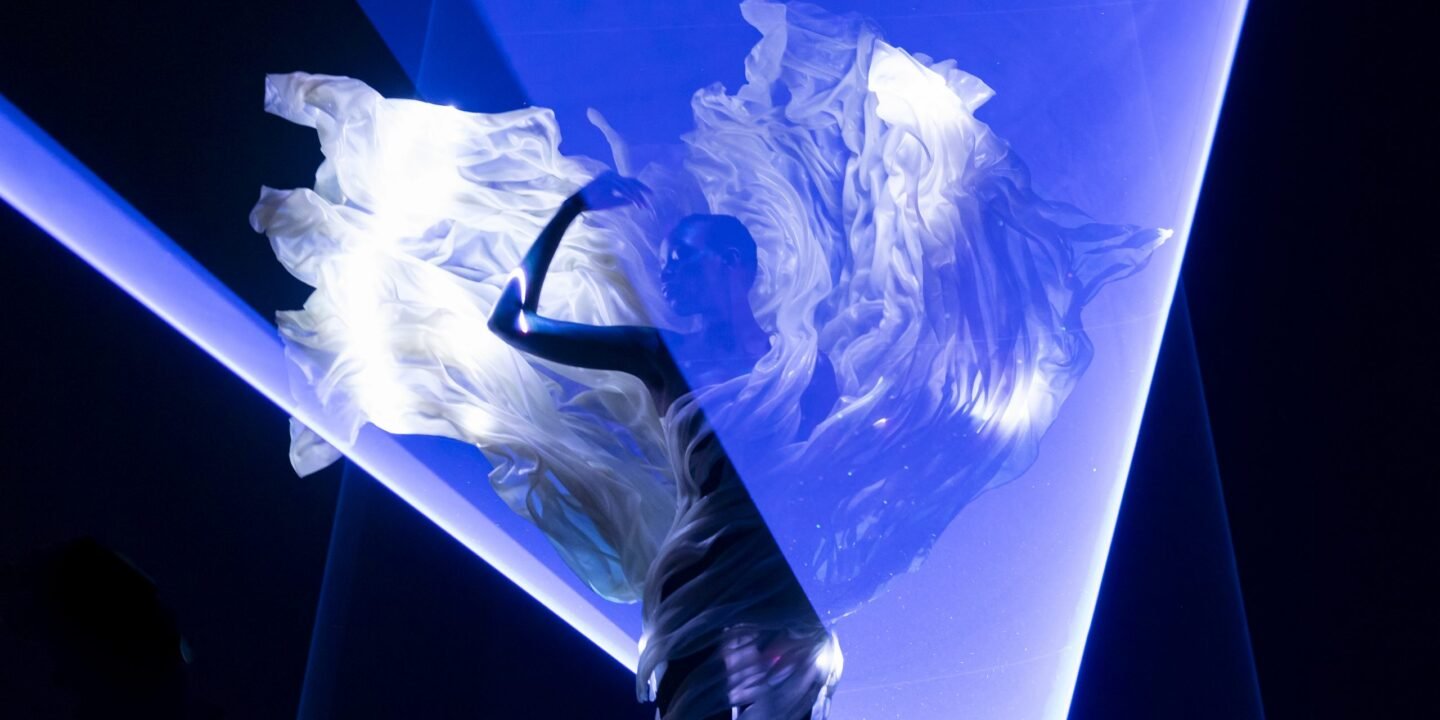
Van Herpen’s own designs are not made to stand still either. Runway videos scattered throughout the show reveal how her works are activated by the human body—they undulate, palpitate, and spiral with the wearers’ movements. “I often look at the garments as micro-dances around the body,” she said. The dynamic textures of her materials come to the fore in the exhibition’s center gallery, where visitors are invited to handle digitally printed organza and silicone spheres.
Movement is also central to one of her newest creations: a blood-red dress magnificent with arches and pleats that Anne Hathaway donned in the 2026 movie Mother Mary. No static garment, it is constructed over the course of the David Lowery film, metaphorically standing in for the spirit of creativity and collaboration.

Iris van Herpen, Red Mother dress for Mother Mary (2026), on view at the Brooklyn Museum. Photo: Min Chen.
“It was so much more than a dress,” said van Herpen. “In terms of aesthetics, in terms of movement, this look is really far away from the usual codes of VIP dressing. It really becomes, in the film, a ghost.”
Future Bodies
The show closes with van Herpen’s visions of a “post-human” future. But where such discourse has usually projected out a few decades to imagine tech-enabled humans, the designer is looking a million years ahead. How will nature take its course? Van Herpen’s designs here put forward human forms integrated with the elements, their silhouettes reformed by air, as in 2017’s Aeriform collection, or waves, epitomized by the Loie dress from 2025’s Sympoiesis collection.
“That is something I’m more intrigued by in the long run: how will our bodies evolve?” she said. “Nature will always keep on creating us. That just sparks my imagination—not thinking in 30 years, but thinking in maybe a million years.”

Iris van Herpen, Phantom’s Coral Dress, from the Sympoiesis collection, 2025. Model: Akuol Deng Atem. Photo: Rob Rusling.
Is she in some way designing with an eye toward that future?
“My mind is not in the future; I try to focus on being here and now. When I try to get into a subconscious state when I design, I always feel those looks resonate to me the most and I somehow speak to the future. The more I plan things out and the more the designs come from my mind, the more current they are,” she said. “It’s as if time is not linear.”
“Iris van Herpen: Sculpting the Senses” is on view at the Brooklyn Museum, 200 Eastern Parkway, Brooklyn, New York, May 16–December 6.
[ad_2]
Source link