[ad_1]
“Poetry is untranslatable, like the whole art.” — Nostalghia (1983)
* * *
The Tomb Beneath
There is a film by Andrei Tarkovsky that has haunted me for years. It is not his most famous, nor his most widely taught in the canons of world cinema. Yet I believe it may be his most personal. Nostalghia, released in 1983, is often described in familiar critical shorthand: elusive, enigmatic, spiritual, slow. What it is rarely described as is autobiographical. Yet that is what I believe it to be, not in an overtly declared form, but inscribed into the grain of its images, the layering of its sound, and the architecture of its unfolding time.
This article is the distillation of an obsession that has grown over years of study. I have watched Nostalghia dozens of times, pausing and annotating, marking the placement of every object, the repetition of every gesture, the recurrence of every sound. I have compared the final film to the original screenplay, tracking how locations have shifted, scenes have been reordered, and motifs have been re-situated. I have treated the film not as a finished object but as a site. What emerged from this process is not a theory in the abstract but a structure I could chart. A second film concealed within the first. Not concealed as a puzzle for the viewer to solve but hidden the way grief is hidden, buried beneath words, beneath memory, beneath time itself.
The more I worked, the more I came to see Nostalghia as a double work. The surface film holds the visible story: a Russian poet wandering through Italy, caught between obligations to his homeland and his own interior life. The buried film holds something else entirely. It is a confession, a record of mourning, and a reckoning with private relationships that could not be addressed in open form. This is not a matter of thematic interpretation alone. It is deliberate, architectural, and exacting in its concealment. The private film is not in addition to the public one; it is within it, bound to it, moving through it like a pulse.

I came to understand that the act of finding this second film required a new kind of approach. Most books and documentaries on Tarkovsky follow one of three routes. The first is biography, which chronicles life, influences, political conditions, and philosophical commitments. The second is filmography, which offers a guided tour of the works, noting their development and reception. The third is a hybrid, weaving life and work together in a narrative of influence and outcome. These are valuable in their way, and I have drawn on them, but they tend to treat the films as completed artifacts. They explain, they interpret, but they rarely enter the work as a space that can still be traversed and discovered.
This project takes a different path. I do not treat biography and filmography as the destination but as the raw materials for another kind of construction. The question is not simply what happened in Tarkovsky’s life, nor what transpires in each of his films, but what those moments reveal when seen as parts of a single, concealed design. In Nostalghia, I believe he built a cinematic tomb. Not a public shrine to abstract ideals of faith or exile, as is often claimed, but something more intimate: a sealed space where personal truths could be placed, arranged, and left to endure, accessible only to those who learn how to enter.
To approach this hidden work, I developed what I call the hieroglyphic method. I name it here because without it the second film remains invisible. It is not enough to note recurring symbols or to map themes. Tarkovsky resisted such simplifications. He believed that art should be experienced, not decoded, that it should speak through its own internal logic. His films do not explain themselves, and they do not yield to those seeking tidy answers. One must enter them slowly, attentively, without the expectation of closure. One must notice what returns, what disappears, what remains unspoken. A candle lit and carried without explanation. A reflection withheld. A gesture performed when no one is there to see it. These are not absences in the sense of incompleteness; they are the marks left by something that has passed through. Each one is a glyph, an inscription left in place of a statement never made aloud.

This confession exists not in the level of dialogue or in the official arc of the plot, but beneath them. Consider, for example, the candle walk that ends the film. It is given no verbal explanation. It is not framed as a narrative resolution. And yet if one sees it in relation to an earlier equation scrawled on a wall – 1+1=1 – and understands it as the fulfillment of a ritual another character could not complete, it begins to take on the weight of inheritance. It becomes a gesture passed from one figure to another, a task undertaken alone and without witnesses, a transmission of duty and grief. This is the language of the hidden film: not exposition but enactment.

The pages that follow are not a survey of Tarkovsky’s work, nor an annotated biography. They are a record of pursuit, of the process by which I came to believe that Nostalghia holds two films within its frame: one seen, one unseen. The visible work follows a man through foreign streets and landscapes. The concealed work traces Tarkovsky’s own act of preservation: mourning a mother, confronting the shadow of a father, and shaping his own memory into a structure that could survive him.
This recognition was not the result of a single moment of revelation. It grew over years of repeated viewings, careful note-taking, and eventually, a scene-by-scene analysis that began to reveal patterns of repetition and withholding. What once seemed like pure abstraction began to feel insistent. What once seemed static began to accumulate force. I stopped watching the film as a linear story. I began to experience it as a reliquary. Every object, every sound, every movement was placed with purpose, sealed within the larger work as if to keep it safe. The visible film was the outer wall; the hidden film was the chamber inside.
What follows will open that chamber. First, I will define the method that makes it possible to see this interior architecture. Then I will lead the reader through the arrangement itself: the nested spaces, the sonic inscriptions, the thresholds that hold the film’s most private gestures. I will argue that Nostalghia is a confession made not through declarative speech but through recurrence and ritual. Finally, I will place it in the context of Tarkovsky’s final trilogy, a cycle that begins in Mirror, finds its confession here, and makes its last offering in The Sacrifice.
We do not begin with answers. We begin with dust.

The Hieroglyphic Method
When archaeologists first opened the tombs of the pharaohs, they found more than gold. They discovered chambers sealed in silence, filled with sacred objects and walls inscribed with symbols no living person could immediately understand. These hieroglyphs were not metaphors to be translated into plain meaning; they were fragments of memory and belief, carved in the only language the dead had left. Meaning survived not because it was spoken, but because it was preserved.
Nostalghia is Tarkovsky’s cinematic tomb. He built it not from plot or dialogue but from silence, time, and memory. His materials were candlelight, water, feathers, footsteps, bells, and static. The film does not unfold like a story; it must be unearthed. And when you begin to excavate it, the first realization is that nothing is literal. Every object and sound is a relic. Every gesture is a glyph. Meaning is not declared; it is entombed.
To understand this structure, I had to invent a new way of reading, one that did not rely on theme, metaphor, or narrative logic. Traditional approaches to cinema – structuralist, psychoanalytic, even poetic – collapsed under the weight of this film. They treated it like a code to be cracked. But Nostalghia is not a cipher; it is a burial site. The reading must begin from reverence. It must preserve the integrity of the wound it seeks to witness. I call this approach the hieroglyphic method.
This method is not a theory; it is a practice of attention. It does not attempt to translate Tarkovsky’s work into symbolic allegory. It bears witness to the language he actually used, a language of memory traces, repeated objects, sonic motifs, and sculpted absences. The film is not metaphor; it is memoir. Every element holds personal resonance, even when that resonance remains inaccessible to us.

In this framework, a hieroglyph is not a symbol that points to universal meaning but a compressed vessel of private history. Like the inscriptions carved into ancient tombs, these fragments cannot always be deciphered. But they must be honored. The feather does not mean freedom. The mirror does not mean truth. The bell does not signify ritual. These are not metaphors; they are inscriptions. They preserve a wound.
Once this shift in reading takes place, the recurring elements of the film begin to arrange themselves into patterns, each one a distinct class of glyph. Tarkovsky’s hieroglyphs fall into three primary categories, as follows.
- Visual Recursions: Certain objects return again and again, not only in Nostalghia but across Tarkovsky’s entire body of work. A piece of white crochet fabric. A falling feather. A mirror that reflects the wrong person. A candle carried through silence. A corridor frozen in symmetry. These are not props; they are psychic fossils. The crochet appears in Solaris, Mirror, Nostalghia, and The Sacrifice, often near the bed, the body, the site of mourning. The feather falls at moments of metaphysical rupture in Ivan’s Childhood and Nostalghia. The mirror in Nostalghia shows Domenico where Andrei should be, not as a surreal flourish but as a statement of inheritance. The grief returns. So do the objects.
- Sonic Hieroglyphs: These sounds are not part of a traditional score. They are interruptions and thresholds. The metallic grinder cuts through moments of quiet. A bell tolls in two distant locations, without explanation. Chanting rises from nowhere. Static flickers like a metaphysical pulse. These are not ambient effects; they are carvings in the soundtrack. They do not accompany meaning; they announce its presence. They mark transitions between the surface film and the submerged architecture beneath.
- Withheld Confessions: Some of Tarkovsky’s most powerful glyphs are absences. The mother we never fully see. The shrine that offers no blessing. The letter that is read but never reaches its listener. These are not narrative ellipses; they are spiritual scars. Tarkovsky withholds closure not to frustrate but to protect what cannot be named. Each withheld image is a hieroglyph in negative space. The candle walk, performed in silence and solitude, is not incomplete; it is sacred because it happens without an audience.
To read Nostalghia in this way is not to impose meaning; it is to receive the film on its own terms. One cannot search for structure or symbolism in the conventional sense. One must become an archaeologist of grief. The task is to watch for returns, to listen for residue, to remain still before the unresolved. Tarkovsky’s cinema resists interpretation because interpretation seeks resolution. But his films are not meant to resolve; they are meant to endure.
The first image in Nostalghia I call “the Polaroid.” A mother, a grandmother, a sister, a boy, a dog, a field, and a majestic white horse. Like a Polaroid, the image freezes. This is not memory; it is the moment a memory becomes relic. Tarkovsky does not guide our gaze; he invites disorientation. That unease is the point. It is how loss feels.


This is what it means to use the hieroglyphic method – to see the film not as narrative but as inscription. To feel the shape of a memory that was never made for you but still includes you. Tarkovsky was not hiding meaning; he was sculpting it in a form that could survive silence.
The sections that follow apply this method directly, not through interpretation but through careful attention. The gestures are already present. The glyphs are already carved. We do not need to explain them. We only need to remain still long enough to read.
The Unreliable Artist
Andrei Tarkovsky told us what he believed about his work. Yet even in those declarations, something remains unspoken. Over and over, he insisted that his films were not symbolic, not allegorical, not autobiographical. He urged us not to decode, not to chase meaning through interpretation, not to reduce his cinema to fixed ideas. Critics responded in opposite ways: some took him entirely at his word, others treated the refusals as a challenge. Neither reaction quite captures what is at work in these denials. Tarkovsky’s disavowals were not intended as a trick, nor as simple misdirection. They were a form of self-protection.
To watch Nostalghia closely is to encounter an artist shaping a work that is less about being understood than about surviving the moment of its creation. Grief has already entered the frame. Family permeates the architecture. And yet no character speaks the names that matter. The son does not address the mother. The figure of the madman does not name the father. There are no explicit confessions, no flashbacks to explain a wound, no verbal acknowledgments of loss. What remains is silence, atmosphere, and recurrence. Meaning drifts beneath the surface, withheld from direct articulation.
This is the terrain of the unreliable artist. The term originates in literature, describing a narrator who cannot or will not reveal the full truth. This is not necessarily because they are lying. Often, it is because they are wounded. In Tarkovsky’s case, that wound was spiritual and deeply personal. His silence is not evasion but reverence. His refusal to explain is not arrogance but an act of grief that resists translation.
To accuse him of contradiction is to misunderstand the register in which he was working. He was not manufacturing falsehoods for the sake of obscurity; he was practicing an art of concealment. The resistance to interpretation was not elitism; it was a ritual of privacy, a veil across what he considered sacred. What he withheld was not the fact of meaning itself, but the lived memory behind it.

The years surrounding the making of Nostalghia demanded such concealment. Tarkovsky had left the country that had shaped him. His mother had died. His work had been suppressed by censorship. He lived in exile, unsure if he would ever return to the landscapes that had defined his imagination. Under such conditions, what could be spoken plainly? What could be confessed without consequence? The original screenplay ended with a note: “Moscow and Rome, 1978–82.” This line does not appear in the finished film, yet it hovers over the work like an invisible date inscribed in stone, marking a span in which mourning and displacement fused into a single state of being.
Rather than speak directly, Tarkovsky placed his grief into form. He returned to images of houses that could not hold families. He reintroduced the figure of the mother without showing her face. He buried personal objects across his films as if they were relics from a private chapel: a bottle, a chair, a scrap of fabric. These are not symbols in the conventional sense; they are inscriptions, carrying weight only if one knows the wound they commemorate.
His interviews remain in the register of abstraction: art as spiritual act, cinema as poetic language, meaning as something never to be fixed. Yet in the films themselves, something else rises through the abstraction. A man is speaking without language. A son is preserving what he cannot openly declare. A father is trying to pass something forward before time runs out.
It is necessary to hold two truths at once. Tarkovsky was sincere when he rejected the idea that his images were symbols to be decoded. He meant it, and he believed it. Yet he was also shaping something intensely personal, and he knew it. The man who insisted that the feather, the breast, the candle were not symbols is the same man who placed them with deliberate care. These images are not puzzles for the audience to solve; they are acts of concealment: private statements turned into form.

Tarkovsky once wrote that the artist does not solve problems, he bears witness. He does not instruct, he endures. This principle is both the ethos of his cinema and a clue to its hidden structure. If Nostalghia is a memory built into architecture, then his denials are part of that architecture. They are not a rejection of meaning, but the creation of the conditions under which meaning can remain hidden.
When Tarkovsky warned us not to seek meaning, perhaps we misunderstood. He was not denying its existence. He was declaring that meaning did not belong to us. The confession in Nostalghia is not for the audience’s possession; it is for the maker’s survival. The Milanese maid who burns down the house, the man who locks away his family to protect them from an ending he alone foresees, the woman whose suffering is ignored by those around her – these stories may remain opaque to us, yet they hold their own clarity for him.
What I have sought in this article, and in the larger work it draws from, is not to claim ownership of Tarkovsky’s meaning but to see the film as he might have seen it. Each relic, each image, each sound is treated not as a clue in a code but as an imprint of a memory preserved. The goal is not to solve but to understand why something was hidden and how it was made to endure.
To take Tarkovsky seriously is to recognize that his refusals are not barriers to interpretation but the very form in which his confession survives. He was not prepared to speak it aloud. Instead, he gave us everything else.

The Double Narrative
Nostalghia appears, on its surface, to follow a Russian poet named Andrei who has come to Italy to research the life of a forgotten composer. He is accompanied by a translator, Eugenia, who grows increasingly impatient with his emotional distance and lack of engagement. Along the way, Andrei meets a local outcast named Domenico, a man whose notoriety stems from once locking his family inside their home to protect them from a catastrophe only he foresaw. As the days pass, Andrei begins to falter. His dreams thicken, his wandering becomes more erratic, and his encounters less tethered to a conventional reality. Finally, he attempts to fulfill Domenico’s strange request: to carry a lit candle across the drained thermal baths of Bagno Vignoni. He completes the walk. Then he collapses.
That is the surface film: a meditative study in spiritual exhaustion, a slow movement through alienation, exile, and the paralysis of artistic will. Yet the surface is not the whole film.
From the opening frames, Nostalghia contains another current, one that runs parallel to the plot but is not bound to it. This hidden film does not advance through dialogue or narrative logic. It is carried by the placement of bodies in space, the recurrence of objects, the modulation of sound, and the careful elongation of time. Rooms echo each other. Camera movements withhold the expected reverse shot. Gestures repeat in altered form, as though passed from one character to another. A sound heard in one location returns in another where it could not logically exist. These are not accidents of atmosphere but intentional patterns, a second film woven into the first, carrying an unspoken confession.
This hidden narrative is autobiographical in structure, though not in the literal manner of a dramatized life story. Beneath the account of a Russian poet in Italy, Tarkovsky has inscribed a private drama: the mourning of a son caught between the absence of his mother and the unreachable figure of his father.
Eugenia is more than a translator in this hidden film. She is a reconfiguration of the mother, not as a symbol but as a presence reframed. She is capable, articulate, and utterly unseen by the man she serves. Her role is aligned with imagery of devotion – the Madonna shrine, the liturgical chant – yet she receives no reverence in return. When she exposes her breast in the hotel room, the gesture is neither erotic nor manipulative. It is an emblem of what has already been given without acknowledgment: language, care, loyalty. Her frustration is not with Andrei alone. It is the cumulative silence of a lifetime, the burden of motherhood carried without recognition.

Domenico is likewise transformed in the hidden film. He is not merely an eccentric, nor a stock “madman” figure. He becomes a fractured echo of the father, inhabiting a home that is neither domestic nor secure. His rooms are unmoored from ordinary architecture – staircases without clear destination, walls opening into vast exposures – as though the space itself has been broken open by time. He speaks in aphorisms, like a man who once trusted in the power of poetry but has lost the audience who could receive it. His voice, dubbed in Italian, feels both his and not his, as if his speech has already been translated away from its origin. He tries to pass on a ritual but cannot complete it himself. Even his death, by self-immolation, is absorbed by the crowd as spectacle rather than sacrifice.
Andrei absorbs the burdens of both figures. He does not verbalize this inheritance; he enacts it. His candle walk is not a performance for others. There is no audience in the baths, no acknowledgment when he succeeds. It is a solitary rite, the completion of a gesture the father could not fulfill, undertaken in the absence of the mother who could not wait for him to return. The act is not based on belief in a miracle, but on the fact that belief itself has been left in his care. The walk becomes an act of filial obligation, a form of service that is also an elegy.
Throughout Nostalghia, the formal choices reinforce this doubled structure. Rooms are revisited in altered states, as though they belong to different levels of memory. Reflections in mirrors shift position or vanish entirely. Objects reappear without visible transport: a bottle, a lit candle, a chair that has traveled across scenes. The flooded ruin where Andrei collapses near the end is more than a physical site. It is the architecture of breakdown – a spiritual chamber in which exhaustion, devotion, and failure coexist. The baths of Bagno Vignoni are likewise stripped of their sacred vitality. They are drained. Domenico’s invocation of Saint Catherine meets not with revelation but with silence.
These are not merely poetic images to be admired for their beauty. They are containers for memory, sculpted into the film’s very form. They hold the tension between what is visible and what is withheld, between the public narrative and the private confession.
This is the double narrative: one film visible to all, a quiet story about a Russian poet’s journey in Italy; the other embedded within it, a metaphysical confession of a son’s mourning and a son’s inheritance. The gestures of the surface film are charged with the private grief Tarkovsky could not state openly.
He never admitted this second structure existed. He maintained there were no symbols. He discouraged interpretation. In one sense, he was correct: the meaning here is not ours to possess. It belongs to the life that shaped it – to the memory of a mother, to the distance of a father, to the demands of an artistic vocation lived under the pressure of time. The key is not to decode but to observe how it was made to exist alongside the surface film, how it was concealed yet left entirely present.
What follows will trace the formal method that makes such concealment possible: the deliberate use of duration, recurrence, and spatial dislocation to build a structure that can hold two films at once. In this architecture, what could not be spoken is not erased. It is sculpted into time.

Sculpting in Time
In 1985, Andrei Tarkovsky published his book Sculpting in Time, a work that has become a cornerstone of cinematic thought. It is read as a poetic meditation on rhythm, memory, image, and belief. Its passages have been quoted endlessly, passed among filmmakers and cinephiles as aphorisms. Yet for all the reverence it has received, the phrase itself has remained strangely abstract. It is often invoked as metaphor rather than understood as a method.
In Nostalghia, the concept is not simply an idea about cinema. It becomes an active technique, a tangible shaping of time as material. When viewed through the lens of the hidden film, this shaping acquires a sharper purpose. Tarkovsky does not elongate moments to produce atmosphere for its own sake. He uses time as an instrument to surface what cannot be spoken: the grief of a son, the burden of inheritance, the persistence of memory across silence. Duration becomes the means by which the autobiographical current fuses with the visible narrative.
Two extended encounters anchor this temporal strategy. They stand like pillars on either side of the film’s spiritual architecture: one in the realm of the father, the other in the realm of the mother. They are not narrative climaxes. They are confessional spaces. And in both, time is not moving forward toward resolution; it is holding still to let buried meaning emerge.
In the father’s realm, Andrei enters the fragmented interior of Domenico’s dwelling. This is not a home but a ruin, located in upper Bagno Vignoni, disjointed and uncertain in its spatial logic. The moment he crosses the threshold, ordinary geography dissolves. Rooms seem to expand or contract. Corridors turn back on themselves. Windows admit light without revealing the outside world. The camera floats rather than observes, refusing to give a definitive map. Time here is not chronological but layered, thickened by sonic traces: the wet drip of unseen water, the grinding rasp of metal, the subtle pulse of air moving through unseen spaces. These sounds are not background; they are sonic hieroglyphs, marking shifts between layers of memory.

The meeting between Domenico and Andrei is stripped of narrative drive. No argument is resolved, no secret is revealed. Tarkovsky holds the shot long enough that the stillness becomes the subject. Domenico speaks in warnings and fragments, his voice mediated by dubbing, as though translated from another state of being. He moves deliberately among the objects in the room – a candle on a shelf, a bottle, a mirror – as if each is an emissary from a past he cannot entirely explain. These are not symbolic props but personal relics, fragments that will reappear later in Andrei’s world. Without declaring it, the scene becomes an act of transfer: what the father cannot complete will now fall to the son.
The mother’s realm takes shape in the hotel room scene with Eugenia. Here, too, Tarkovsky replaces drama with stillness. Eugenia stands at the edge of leaving, her body angled toward the door yet rooted in confrontation. Her words are sharp, even accusatory, but beneath them is the fatigue of a caretaker who has given everything and been left unseen. In the register of the hidden film, she becomes Maria Tarkovskaya – not as biographical fact but as distilled presence. She sets down an object on the dresser. The bell rings. Time pauses. The air between them is dense with what is not being said: the cost of nurturing, the pain of being forgotten. Andrei does not respond. He turns away. The camera holds her in the frame long enough that her stillness becomes an unanswered question.
Both encounters demonstrate that sculpting in time is not a neutral aesthetic choice. It is a way of allowing private memory to remain whole, unforced into explanation. In the father’s room, time shelters a handover. In the mother’s room, it preserves a wound. The surface film can only gesture at these exchanges. It is the temporal shaping – the refusal to cut, the insistence on letting a gesture remain – that allows the hidden film to register.
This strategy reaches its most distilled form in the candle walk. It is a scene without plot function, without witnesses, without reward. Andrei enters the drained baths of Bagno Vignoni carrying a lit candle. The emptied pool is no longer a location in the story. It has become a chamber of trial. His footsteps echo with a weight disproportionate to their volume, as if the space itself is amplifying the effort. He shields the flame with his hand, takes a few steps, and fails. The candle gutters out. He returns to the start, relights it, begins again. He fails again. And again, he returns.
The sequence is presented in a single unbroken shot. There is no score, no explanatory dialogue, no cutting to relieve the duration. The camera tracks Andrei in profile, its slow forward motion matching his pace. The effort becomes the entire content of the scene. This is not symbolism to be decoded; it is an action to be endured. The son takes on the task the father left incomplete. The completion is not a triumph but a fulfillment of obligation.
When Andrei finally places the candle at the far edge of the pool, there is no celebration. No one is there to acknowledge it. He collapses off-screen. The sound of his fall tells us more than any image could. What remains is the candle, burning for as long as it will, in a space emptied of audience and explanation.

This is sculpting in time as Tarkovsky practiced it in Nostalghia: not a slowing for its own sake but a shaping of duration so that the weight of another’s absence can be carried forward. The autobiographical layer does not intrude on the surface narrative; it is braided into it through the rhythm of experience itself. The mother’s silence, the father’s inability to finish, the son’s repeated attempts – all are joined not by exposition but by time held open until gesture becomes inheritance.
In the space between frames, and in the long unbroken moments that refuse to yield to narrative efficiency, Tarkovsky allows something sacred to survive. What could not be said aloud is given form, not as explanation but as presence. And through that presence, the hidden film becomes visible.
The Sonic Body
Tarkovsky dreamed of making a film without music. Not out of austerity or rejection, but because he believed that sound, real sound, the sound of time, was already enough. Music, for him, was a dangerous seduction. It threatened to manipulate, to overstate. But in Nostalghia, he nearly accomplished his dream. What remains in the film is not score but sonic inscription. Not music as commentary but music as memory. A body of sound, composed as ritual.
The film opens with a voice already lost. Olga Sergeeva’s Russian folk recording of “Kumushki” plays over the opening Polaroid scene. A white horse drifts through fog. The family walks down a hill, the boy swimming in his father’s coat. But the father is not there, just like Tarkovsky’s father, Arseny, who never returned home after the war. This is not an opening tableau. It is a wound. The sound is Russian. The voice is maternal. The absence is paternal. The melody descends not from the world of the film, but from Tarkovsky’s mother’s own buried memory.
Oh my girlfriends, be sweet . . . you will go to the green garden, take me with you . . . your wreaths will float on the water, but mine will sink to the bottom . . . your boyfriends returned from war. Mine did not.
The lyrics are not subtitled. Tarkovsky offers no translation. And yet their meaning is carved into the sound itself. “Kumushki” speaks of loss, exclusion, longing. It is not sung outward but inward. Sergeeva does not perform it for an audience. She sings it for herself. This inwardness is central to the film’s spiritual register. The voice becomes maternal memory, spoken from exile, to the boy who will never return.
As the Polaroid scene continues, “Kumushki” fades and is quietly replaced by Verdi’s Requiem. The transition is seamless, nearly imperceptible. The credits continue to roll. No one notices the shift. But this change, from folk lament to Catholic liturgy, is the hidden key to the film. Tarkovsky is telling us what Nostalghia is. It is not just a story of exile; it is a mass for the dead. And not for Russia. For his mother.
The Requiem is not introduced. It is not explained. It is woven into the very beginning of the film like a liturgical secret. This is not a score; it is a funeral. The title card will later confirm what the sound already knows: To the memory of my mother. The sonic structure has made the dedication before the text appears.
And then “Kumushki” returns.

At the end of the film, after the candle has been carried, after Andrei has collapsed, after the dacha has been revealed within the ruined cathedral, we hear Sergeeva’s voice again. The same folk song that opened the film now becomes its benediction. But it is not the same. Now it plays over snow, over stone, over the weight of the entire film. It is not reprise; it is return. The voice that once called to the father now mourns the son.
Between these two musical events, Nostalghia refuses a traditional score. It gives us no themes, no motifs, no emotional cues. But there are two more moments of composed music, both carrying enormous spiritual charge.
In the House of the Father scene, a movement from Beethoven’s Ninth Symphony plays in the background. A lesser-known section, slow, mournful, unresolved. It drifts through a ruined space filled with statues and dust. “Did you hear that? Beethoven” Domenico says from the darkness. Andrei and Domenico speak, but say very little. Their conversation is elliptical, haunted. The music does not guide it; it mourns it, as if something sacred has already passed between them, and the sound is only its echo.
Later, in the Piazza del Campidoglio, Beethoven’s Ode to Joy stops and starts, blaring from loudspeakers as Domenico delivers his final speech. It is not triumphant but distorted, misaligned. The anthem of human unity becomes noise. The voice of a madman is drowned by a hymn no one hears. Tarkovsky weaponizes Beethoven’s utopianism, turning connection into confusion. The music becomes a wall.

These four movements, “Kumushki,” Requiem, Beethoven’s Ninth, and Ode to Joy, form the true structure of the film. They are not score but signal. Four sonic doors.
- From folk memory to maternal elegy.
- From spiritual inheritance to public deafness.
No other music intrudes. Everything else is silence, resonance, or trace.
What Tarkobsky left is something far more profound, a sonic body. Not a composition. A memory. A ritual. A farewell.
The viewer is not asked to listen but to carry.
This is the final burden of the hidden film. The candle cannot be held in silence alone. It must be accompanied by the faint sounds of everything that could not be said. The folk song no one translated. The requiem no one noticed. The anthem no one heard.
And in these sounds, unresolved, untranslated, unclaimed, we begin to hear Tarkovsky himself. Not explaining. Not justifying. But remembering. The noise of absence. The voice of the dead. The weight of inheritance. Sculpted not in time but in vibration.

The Trilogy of the Soul
Through the excavation of Nostalghia, I returned again and again to Tarkovsky’s body of work. Each time, what began as a close reading of a single film expanded into something broader: a recognition that Mirror, Nostalghia, and The Sacrificeform a continuous movement. Tarkovsky never announced them as a trilogy, yet the deeper one looks, the harder it becomes to ignore the thread binding them together. The connection is not one of plot or character. It is one of position, of who is offering and to whom the offering is made. These films feel like three linked confessions, each addressed to a figure Tarkovsky could not reach in life.
In Mirror, the son turns toward the mother he could not protect. It is a film made out of fragments because fragments are all that remain. The camera moves like memory itself – drifting, doubling back, holding too long – and the voice of the son addresses the mother as if the act of remembering could still bring her closer. In Nostalghia, the son inherits the weight of the absent father, a man he cannot save yet whose unfinished burden must be carried. The gesture here is not to restore but to continue. And in The Sacrifice, the father fully inhabits his role and offers himself in place of his own son, sealing a vow that may never be understood by the one it was meant to protect.
This is not linear progression but a turning of the same wheel. The son becomes the father. The offering changes shape, yet it is always the same act – an intimate vow made in the absence of the one who needs to hear it. Tarkovsky’s art in these films is not about closure. It is about living within the unfinished.

Nostalghia is the keystone because it carries both directions of this exchange at once. It still looks back to the mother, even as it begins to take on the voice and posture of the father. It inhabits the midpoint where memory and sacrifice are not yet separate, where grief and duty blur into a single, unbroken gesture. The candle walk is the most visible emblem of this balance. It is inherited from Domenico yet walked alone. It honors another’s intent while making it one’s own. And like the fragments of Mirror, it arrives without explanation, because explanation would reduce it to something smaller than it is.
This trilogy also reveals itself through Tarkovsky’s private language of recurring images – what I call glyphs. Water flows in every one of these late works, but never in the same way. In Mirror, it drips from a basin and ripples across a mirror’s reflection, tied to childhood interiors. In Nostalghia, it pools in ruins and laps at the edges of memory, unclaimed by any living figure. In The Sacrifice, it is reduced to the stillness of the sea, as if exhaustion has slowed the current. Fire follows a similar path. In Mirror, it is contained – a hearth, a controlled burn. In Nostalghia, it is the imagined blaze of the Milanese maid’s story and the final act of Domenico’s self-immolation. In The Sacrifice, it is total, a house engulfed, the offering completed. The change in scale is not random. It reflects the transformation of the gesture itself: from the small and personal to the absolute and final.

Other glyphs make the same journey. The feather falls in Ivan’s Childhood, Andrei Rublev, and Nostalghia, but in this trilogy it shifts in meaning – from the delicate remnant of a lost past in Mirror, to the suspended grace that precedes collapse in Nostalghia, to its absence altogether in The Sacrifice, as if the world has moved beyond signs into the act itself. Dogs wander through all three, yet in Nostalghia they seem most untethered, most like carriers of a message from one space to another. White fabric, the brass bed, the boy with blond hair, the man on fire – none of these are explained, yet they bind the films together through the persistence of their return.
Placed in this continuum, Nostalghia is not just another Tarkovsky meditation on exile or memory. It is the pivot where the inward turn of Mirror meets the outward offering of The Sacrifice. In Mirror, Tarkovsky reconstructs the textures of his childhood, addressing a mother whose love and absence shaped him. In Nostalghia, he steps into a different inheritance – the father’s – with its own kind of absence, one defined by abandonment and unfinished vows. By the time of The Sacrifice, the father is present in full, speaking directly, acting decisively, offering himself to save the son. The progression is not about biography so much as the deepening of an artistic vow: to carry the burdens of those who could not finish their own walk.
Understanding the trilogy this way changes how we read Nostalghia. It is no longer simply a film about alienation or cultural displacement. It becomes the hinge between private memory and public sacrifice, the place where Tarkovsky’s art begins to accept that what has been lost cannot be restored, yet must still be honored through repetition. The film’s glyphs – the bottle, the mirror, the candle, the water – are not metaphors to decode but fragments of a private lexicon. They carry meaning only because they return, and because they return, they become sacred.
To see Mirror, Nostalghia, and The Sacrifice as a trilogy is not to force a structure onto them. It is to recognize that Tarkovsky’s cinema, at its most personal, forms a cycle of endurance. The same gaze that opens Ivan’s Childhood reappears in the boy at the end of The Sacrifice. Between them stands Nostalghia, where the gaze is older, heavier, tempered by the act of carrying forward a task that belongs to someone else. In this middle movement, the private wound becomes aware of itself as something that can be – and must be – given to another.
The trilogy of the soul is, finally, a record of passing gestures through time. It is the son remembering the mother, the son inheriting from the father, the father offering to the son. Each film stands alone, but together they form a spiritual relay. Nostalghia is the handoff, the moment when remembrance turns into responsibility. In that passage, Tarkovsky’s art becomes not just a repository of his own memory but a vessel for whatever the next in the chain might need to carry.

The Architecture of Memory
Tarkovsky once wrote that a landscape in cinema is never simply a backdrop. It is an active participant, capable of revealing a character’s state of soul. In Nostalghia, he advances this principle into something more intimate. Architecture itself becomes memory. A room is not merely a location to be inhabited. It is a threshold, a chamber of psychic residue, a vessel for grief. Every major structure in the film holds a different strain of Andrei’s mourning, and each one embodies a different aspect of Tarkovsky’s private confession. The buildings do not simply contain the events of the story. They are the film’s internal organs. They store loss, transmit pain, and shape how that pain is experienced.
Nostalghia is assembled from these architectural vessels: flooded ruins, narrow corridors, crypt-like hotel rooms, deteriorating shrines, cloisters that seem to dissolve into dream. These spaces do not function as traditional sets or as symbols to be decoded. They operate as spiritual containers. They preserve what Tarkovsky cannot voice directly. Even when the surface geography of Italy remains intact, the physical locations collapse inward, merging into an interior topography. The characters move, but they do not truly traverse Italy. They drift through the architecture of Tarkovsky’s own inner landscape, each space a kind of reliquary.
The flooded monastery is the first of these major structures to announce itself. It is never named or explained, yet it returns at decisive moments, gathering meaning with each appearance. Here, Andrei collapses. Here, the feather falls through the air. Here, the burning book is offered to water. Each of these actions functions as a glyph in Tarkovsky’s personal lexicon – a fall, a visitation, a sacrifice – but the building itself is the element that binds them. The monastery is not simply a ruin. It is a container of relics. Its crumbling walls and open ceiling are not evidence of destruction but of exposure. They let in weather. They let in time. They let in the memory that will not leave.

Tarkovsky’s camera treats these surfaces as if they were alive. The stone glistens with dampness. Light slants through openings in ways that feel sculpted rather than incidental. Water ripples across the floor in small, constant gestures. The building breathes in its own rhythm. Andrei is never entirely alone here, even when he is the only figure in the frame. The space itself is a companion. It does not shelter him from grief; it receives him into it. The monastery becomes a presence – a place situated between mother and father, between artist and child, between collapse and any hope of resurrection. It is a temple of irresolution.
From here, the film moves into the corridor: a narrow, modern hallway within the hotel. At first it appears inconsequential, a utilitarian passage from one room to another. But Tarkovsky returns to it, and each return alters its emotional charge. Early on, Andrei walks through it in a posture of exhaustion, a staircase rising alongside him. Later, the space seems to watch him, as a white statue becomes visible at the far end. These are not pragmatic transitions between locations. The corridor functions as a cloister disguised in domestic form. It is liminal, transitional, but deeply interior. Tarkovsky’s symmetrical framing and deliberate camera movement elevate the hallway into a monastic passage. It becomes a site of private reckoning, one in which the simple act of walking forward feels ritualized.
This hidden cloister is echoed more explicitly toward the end of the film. The camera glides along a colonnade of arches in black and white. Andrei walks alone. Over this image, we hear Eugenia’s voice, praying to God on his behalf. She is not physically present, yet her presence saturates the space. The cloister absorbs her voice, just as the hotel corridor absorbed Andrei’s earlier fatigue. The architecture has shifted in meaning without changing in form. What was once modern has become monastic. What was once functional has become ceremonial.

The shrine to the Madonna of Childbirth is another critical space in this architecture of memory. It appears early, before the full structure of the hidden film reveals itself. A crowd of women has gathered inside, weeping and praying for motherhood. Eugenia enters but does not join them. She remains standing, unable or unwilling to kneel. When she passes in front of the Madonna fresco, Tarkovsky holds the frame as if waiting for something that never comes. The scene is not about epiphany. It is about refusal.
The refusal is layered. On the surface, it is Eugenia rejecting the ritual, resisting the prescribed role. Within the hidden film, it is Maria Tarkovskaya, Tarkovsky’s own mother, turning away from the mythology of motherhood. This is not a rejection of faith itself. It is a refusal to return to a role that has already cost her everything. The shrine, with its fresco and its gathered women, becomes a space of confrontation between generational grief and personal boundary. It stands as both a holy site and a final line drawn.
These spaces – the flooded monastery, the corridor, the cloister, the shrine – make up the architecture of Tarkovsky’s grief. They do not obey continuity of time or distance. The characters move between them in ways that ignore physical logic. Realism gives way to a metaphysical geography in which distances collapse and one room becomes another without explanation. The purpose is not to depict coherent travel but to evoke recurrence. A shrine becomes a corridor. A corridor becomes a cloister. A cloister dissolves into water and silence.
Within each space, objects take on the weight of relics. The candle in the shrine. The green bottle on the shelf. The burned book left in water. The brass bed, the statue, the white cloth. These are not placed as metaphors but as preserved fragments, each embedded in a room that cannot be revisited in life. Cinema becomes the only way to re-enter them. Tarkovsky’s spaces are not sets to be exited; they are memory rooms to be re-entered over and over.

As the film moves toward its end, the architecture becomes increasingly elemental. The shrine yields to the corridor. The corridor yields to the flooded monastery. The monastery yields to the cloister. Finally, even the cloister is gone. All that remains is the candle and the act of walking. The built environment has been stripped away until only gesture remains.
By the final image, there are no walls. The film ends in an unbounded cathedral, a house made of light, fog, and sound. Memory has shed its structure. The architecture has dissolved into pure presence. What remains is a space not for living but for holding the unspeakable. It is a structure built entirely from grief, yet one that makes room for the sacred without promising redemption.
The architecture of Nostalghia does not lead to revelation. It leads to stillness. Stillness that contains what Tarkovsky could not say aloud but could shape into form. And in that stillness, the final door opens – the door that leads back to the mother. We turn to her next.

What Remains of the Mother
The final frames of Nostalghia do not offer peace. They offer absence. Not as a void to be filled, but as the very substance of what survives. The mother, who has hovered in silence throughout the film, now vanishes completely. No name is spoken. No body is buried. No tribute is performed. And yet the film has already been her memorial.
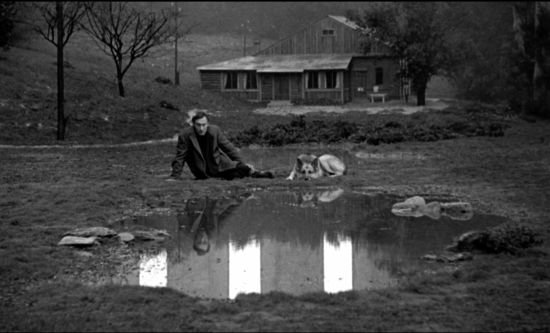
After the candle walk, Andrei collapses off-screen. We do not see his body. We do not hear his final breath. Tarkovsky withholds the spectacle of death. Instead, he gives us something more intimate, more disorienting. The final image reveals the Russian dacha, Andrei’s childhood home, situated impossibly within the ruins of an Italian cathedral. The walls crumble. The roof is open to sky. Snow falls without wind. The dog sits silently beside him. Smoke rises faintly – not as warmth but as the fog of memory.
This is not a place. It is a metaphysical shrine, a final chamber built from fracture. Tarkovsky does not grant resolution. He constructs the architecture of grief. The dacha, long tied to maternal presence in his work, is no longer a domestic space. It is a sealed reliquary. The mother is gone, and her absence defines the frame. The camera holds still. The sound recedes into quiet. Nothing moves. And still, the image lingers.
A faint chorus emerges, a low chant. Whether imagined, remembered, or divine, it remains unclaimed. This is the final sonic glyph. Not a song of resurrection but a dirge. Tarkovsky gives her no voice, no name. He gives her stillness. The entire film rests in the space she no longer occupies.
This is not a story about the mother. It is about what is left in her absence. That loss is not a wound to be healed. It is the soil from which every gesture in the film grows. Andrei’s longing, Domenico’s madness, Eugenia’s fury, the candle’s burden, all of it arises from the silence where she once was.

We never see her. We never hear her. But she remains. In the white crochet cloth that reappears. In the soft light across the brass bed. In the hands that once held a child, now grown and exiled from everything he loved. She is no longer a character. She has become a glyph, a trace, a question that will never be answered.
And then Tarkovsky speaks.
Not with dialogue. Not with music. With text.
Over the image of the dacha, nested in the stone of the cathedral, snow falling gently in silence, a final title appears:
Dedicato alla memoria di mia madre.
To the memory of my mother.
Nothing else is said. The film ends.
This is not a dedication. It is a confession. The entire film was sculpted for her. Not just Eugenia’s anguish or the dacha or the prayer or the poem. The making of the film itself. The sacrifice of exile. The candle. The silence. All of it offered to the one who could no longer be reached.
Tarkovsky once admitted that the final image represents two worlds. The dacha is Russia. The cathedral is Italy. The ending does not take place in either. It takes place in the impossible space between them. A vision of a divided soul. A Russian man sitting in European ruins, holding the shape of his past in memory. The dacha is not behind him. It is beside him. It is built into the frame.
He cannot return. He cannot resurrect her. But he can remember. He can sculpt the space she once inhabited. Not in Moscow, not in Rome, but in the film itself. In time. In snow. In silence.
The cathedral does not stand for religion. It stands for reverence. This was never about belief. It was about memory. Sacred not by dogma but by cost. The mother gave everything. And now she is gone. Tarkovsky cannot bring her back. But he can offer her a final room. A sacred image. A farewell without closure.
The film does not release us. It does not resolve. It lingers. The screen fades, but something continues. That is the work of grief. It does not end. It endures. We leave the theater with the sound of her absence inside us. Not as comfort. Not as clarity. As presence.
That is what remains.

What Cannot Be Said
We have reached the end of the visible film. The house is gone. The flame is out. Snow falls silently inside a ruined cathedral. And yet nothing has ended. Not for Tarkovsky. Not for the viewer. Not for the son who carved his confession into the shape of time.
We have not solved Nostalghia. It was never meant to be solved. We have not decoded it. We have walked beside it, not as critics but as mourners. We have traced the signs Tarkovsky left behind, not to explain his grief but to witness it. The candle. The mirror. The feather. The song. These were never clues. They were never metaphors. They were the language he used when speech was no longer possible.

To excavate Nostalghia is not to unlock it. It is to carry it. To live with its burden. To recognize that behind every withheld gesture lies a wound that could not be shown. Tarkovsky sculpted a hidden film inside the one we see, not to protect a mystery but to protect himself. Not to obscure meaning but to endure what could not be spoken aloud.
This hidden film is not theoretical. It is physical. It lives inside the fog, the walls, the silences. It lives in the choice to dub the father, to exile the mother, to abandon language, to repeat the past in gestures the characters themselves do not understand. Tarkovsky could not resurrect his family, so he made a reliquary. A structure of sorrow. A sacred architecture built from absence.
“Kumushki” and Requiem return at the end not as motifs but as gravestones. The film begins with the mother’s voice and ends with her son’s collapse. Between them lies a son’s failure to return, a father’s absence, a memory that cannot be reconciled. This is why the gestures repeat, why no conversation is complete, why the characters move like echoes. They are not enacting a plot. They are embodying grief. Each act of withholding, each silence, each aborted motion, is part of the ritual. Not a secret to decode but a suffering to endure.
This is not an interpretation. It is an inheritance. What Tarkovsky could not resolve, he passed to us. The film is not a confession. It is a transference.
If you have followed this far, you have seen the relics. You have entered the flooded room. You have walked the corridor. You have waited outside the shrine. You have carried the candle. And you know now what remains when the artist is gone.
Not answers.
Not symbols.
But sound.
And time.
And the silence of the one who could not come home.

And yet I must add this. These are my findings. They may be wrong, incomplete, or awaiting another set of eyes to carry them further. The Hieroglyph Method is not a key that unlocks the film entirely but a way of listening for what returns – a way to follow a filmmaker’s private logic as it emerges, fragment by fragment, across the body of his work. I offer it in the spirit of continuation rather than closure. What I have uncovered is the path as far as I can take it. The rest I leave to the next person willing to walk beside the flame.
* * *
All images are screenshots, with the exception of the public domain image of the Mona Lisa, are from the films discussed.

[ad_2]
Source link