[ad_1]
More and more artists who have used 2D painting tools for years are expanding their craft into other dimensions and mediums. It’s clear that 3D software in particular is opening up new channels of creativity.
Some are going beyond 3D and into AR and physical sculpture. Others are learning game engines. All of this is made more accessible by tools such as the 3D modelling software Blender, Affinity Studio and Unreal Engine being free to use, making it easier than ever to try new things.

Concept artist Jordan Grimmer tells us that learning Blender has been a turning point for him. “It has completely changed how I approach creating images and has removed barriers when it comes to experimenting with different workflows,” he says.
Latest Videos From

“For example, I may use it to create a simple block-out for an environment shot, just to help with perspective and lighting, and then paint over it in Photoshop. Or I might get more in-depth and model a few assets for my own scenes.”

Getting to grips with 3D can be a challenge, and like many, Jordan found other 3D software overwhelming when he tried to learn it. But Blender was different (see our Blender tutorials).
“I think with Blender being free and accessible it’s allowed me to learn at my own pace, and there are so many resources out there to help you along. It’s now an industry standard in my field of video games, too.”

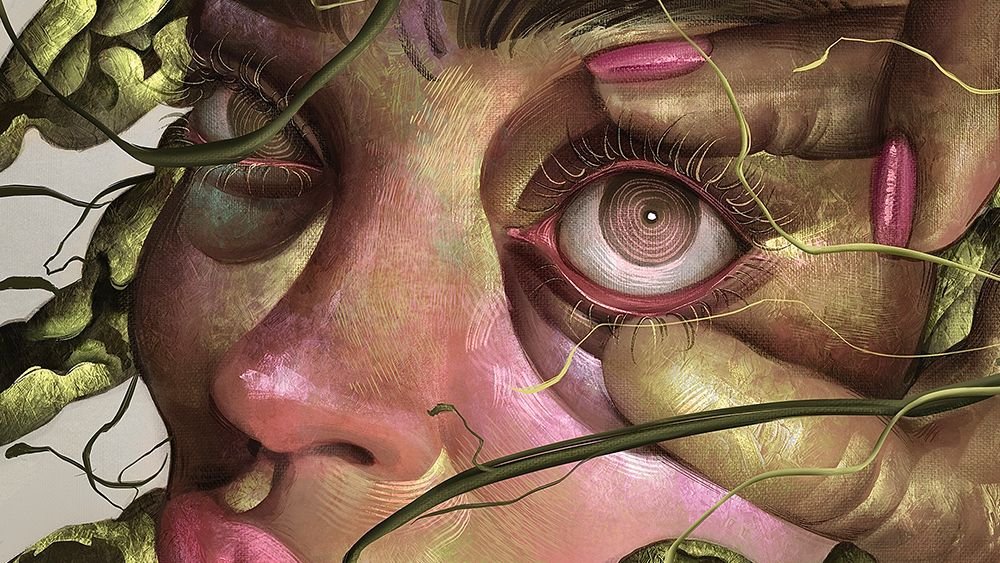
Juliet Nneka, who is an engineer as well as an artist, uses Procreate to paint lush portraits that place female figures within the folds of petals, leaves and fungi. She was inspired to experiment with 3D when she identified a similarity between her 2D art process and her work on a project to design prosthetics based on 3D images made from anatomical scans.

“I was taking a direct imprint of a biological structure and translating it into a digital geometry,” she tells us. “This felt strangely close to what I already do in 2D art: transmuting real experiences or internal images into figurative art.
“That connection made me wonder why I wasn’t doing the same using 3D. So I experimented with painting on scanned topographies and expanding that emotional process into an additional dimension.”
The appeal of Nomad Sculpt

Everything in Juliet’s 2D work is alive, curvaceous and flowing, and these aspects are accentuated in her experiments with 3D. She captures her subjects using photogrammetry (creating a 3D model based on many photographs taken from different angles) and works in Nomad Sculpt.
“I begin by cleaning and repairing mesh topographies in Blender, then bring them back into Nomad to sculpt further and push the stylisation,” she explains. “After that I use my Procreate brushes to paint directly onto the geometry. Then it pretty much mirrors my 2D workflow after establishing values, but with the added dimension of height and physicality.

As Juliet explores the possibilities of 3D, she is finding pathways into other technologies.
“One of the features I’m most excited about is the ability to view my 3D objects in augmented reality through Procreate,” she says. From here, a drive to bring her digital work into the physical realm is emerging.
“Digital art is already inherently ephemeral, but 3D feels closer to a real-world object. This has made me increasingly interested in translating some digital sculpts into physical objects. The bridge between digital ephemerality and a physical artefact feels like a natural progression of the experiment.”
Juliet has noticed that capturing her subjects using these creative technologies instead of drawing them in the traditional way does come at a cost.
“You lose a certain gestural intuition when you rely heavily on references or technical aids,” she says. “But you also gain accuracy, depth, and a different kind of control.”
Weighing these factors is part of the creative process. “It depends on the intention behind the piece. Every tool has a trade-off, and it’s up to the artist to decide what technical qualities matter most for that specific work or workflow.”
As Juliet progresses the work, she sees it evolving firstly into larger digital installations, possibly followed by AR, and finally into something physical.
“I want to keep deepening the connection between my scanned topographies, my sculptural experiments and my painted surfaces,” she says. “The long-term goal is to let the 3D work influence my 2D practice and vice versa, creating a continuous loop between dimensions.”
Creating creatures in Krita
Free tools can be particularly important for artists looking to find new modes of expression. Having to pay a costly subscription every month puts the pressure on someone trying to learn a new tool in their spare time – so much so that they might just not bother.
Creature concept artist and free software aficionado Kelvyn Hulsey previously worked in Photoshop and Clip Studio Paint but now uses free, open-source Krita as his main painting tool.

“Switching to Krita was simple and I found that it had all the necessities of Photoshop, but was more intuitive,” he says. “Where Photoshop feels more like it’s tailored for photographers, Krita felt like it was developed with artists in mind. It had everything that I had loved about Clip Studio Paint, but felt like it was closer to working traditionally, which is important to me.
“That marriage between traditional work and digital is where I find my best creative flow and artistic process. Krita feels so natural that I can do a traditional drawing in a sketchbook and then throw it into Krita to make clean line art and painting without it feeling disconnected.”

Like many artists today looking for new ways to engage audiences with their creativity, Kelvyn is also learning a game engine and developing his own game. His choice is the free and open source engine Godot.
He tells us: “It’s fairly straightforward and easy to learn, and it helps to make the whole game development process feel like making art – which is exactly what it should feel like!”
Kelvyn believes that free tools are “just as good if not better” than the paid-for alternatives. “What they lack in polish, they make up for by taking the feedback of the communities that actively use them,” he says. “It feels more collaborative, and with this open communication, everyone wins.”
He uses Krita alongside PureRef, which he uses to gather reference images without cluttering his workspace on Krita. He also uses PureRef for vision boards for larger- scale world-building projects.
“Krita gives me nearly all I need to create amazing digital art pieces, but in unison with PureRef I feel like everything I need is streamlined and easily accessible,” he says.
“Learning something new can strain your creative process, but that’s temporary, an I always try to remind myself that for an artist, learning is never truly done,” says Kelvyn.
“I think we need to support as many of the free software programs as possible. We want to make sure that they’re around not only for those that might have fallen on hard times financially, but for those who are just entering the digital art field. They are as desperately needed and beautiful as that first pencil and paper in an artist’s hands. And in supporting them, you are supporting the idea that anyone can be an artist.”
This article originally appeared in ImagineFX. Subscribe to ImagineFX to never miss an issue. Print and digital subscriptions are available.
[ad_2]
Source link