[ad_1]
Through two Rolls-Royce Phantom Gallery works for London Craft Week 2026, the marque turns leather, thread, brass and veneer into a contemporary meditation on heritage and handwork
When one thinks of luxury automobiles, one name still carries the weight of ceremony: Rolls-Royce. For more than a century, the marque has set the standard for coachbuilt refinement, turning the open road into a stage for opulence, discretion and command.
Rolls-Royce has long understood what few marques can credibly claim: that a motor car can still be built hand by hand and stand not merely as a luxury object, but as a feat of patience, precision and belief. and the art of precision. Simply put, Rolls-Royce is art on wheels. From Phantom to Ghost, each model moves with a presence that is less about display than dignity.
For London Craft Week 2026, Rolls-Royce is doing something more intriguing than polishing its own mythology. It is opening the bonnet, as it were, on the labour of luxury: the hand, the tool, the eye, the tiny decision that separates decoration from art.

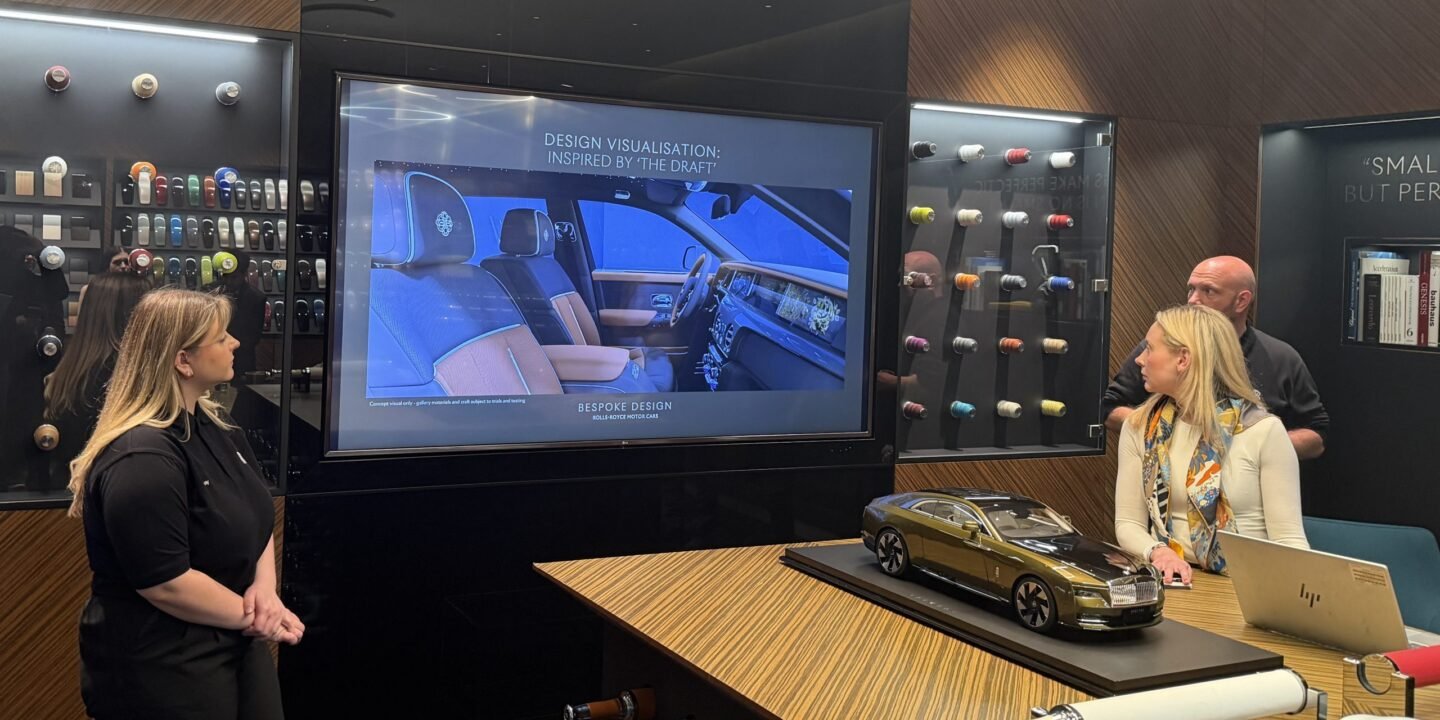
At Rolls-Royce Motor Cars London on Berkeley Street, Mayfair, the marque will present two new works created at the scale of a Phantom Gallery. These are not accessories in the usual automotive sense. They are contemporary craft objects, conceived as miniature worlds inside the architectural calm of a Rolls-Royce interior. The project introduces four new Bespoke techniques: 3D leather hand-sculpting, 3D metal hand-sculpting, 3D veneers and beadwork application.
Rolls-Royce has always sold more than transport. Since Charles Rolls and Henry Royce joined forces in 1904, the brand has carried the grand, slightly theatrical promise of “the Best Car in the World.” Yet the phrase only survives because the making keeps renewing itself. Charles Rolls brought appetite and velocity. Henry Royce brought an engineer’s intolerance of the almost-good-enough. Their meeting in Manchester, arranged through Henry Edmunds, set in motion a company that would come to embody British engineering, social theatre and the deep pleasure of things made properly.
That history matters here because the new Galleries are rooted in the same tension: heritage without nostalgia, innovation without the coldness of novelty. The Rolls-Royce Bespoke Collective, made up of designers, engineers and craftspeople, treats the motor car not as a fixed product but as a surface for cultural expression. In their hands, leather, brass, wood, thread and beadwork become part of a wider conversation about contemporary art, material intelligence and the future of luxury craft.

The first composition, ‘Legacy Craft: Inspired by Still Life’, looks to nature morte paintings of the 17th-century Dutch Golden Age and to the embroidery traditions revived by the Arts and Crafts movement. The reference is precise. Dutch still-life painting was never simply about fruit and flowers. It was a virtuoso test of texture, light, ripeness, reflection and decay. A lemon peel, a glass vessel, a bloom at its peak: each became a small arena of painterly bravura.
Rolls-Royce translates that painterly inheritance into leather and thread. Across the length of the Gallery, artisans from the Interior Trim Centre have composed a three-dimensional arrangement of fruit and flowers. Hydrangeas are built from 50 individual flowers, each hand-sculpted from leather and painted by hand. The petals move through delicate pink tones that deepen towards the centre, a detail that sounds botanical but reads almost painterly. Floral twine secures the flowers to the Gallery surface, while the leaves are formed entirely from thread using a newly developed technique, Sphinx Moth 3D embroidery.
The pomegranates bring another register of abundance. They are embroidered using the alternate stitch technique, with 76 jewel-like beads hand-sewn to create seeds that echo the ruby translucence of the fruit. The colour palette is rich without shouting: Peony, Cocoa and Chartreuse give the work its lush, almost edible charge. More than 250 hours of handwork were required to complete the Gallery. That number is not just a statistic. It is the real subject of the piece.
The second work, ‘Legacy Craft: Inspired by The Draught’, shifts from the sensuous language of still life to the discipline of architectural making. Created by specialists from the Interior Surface Centre, the artwork combines 3D metal hand-sculpting, layered 3D veneer and brass elements. It is conceived as a piece of fine jewellery, which feels right. There is a glinting, engineered intimacy to it.
Its references are drawn from the history of construction and ornament: the draught, meaning the technical drawing used to guide architectural work; scribing, the marking of a surface before cutting or carving; strapwork, the interlaced band motif associated with Elizabethan and Jacobean design; and ferramenta, the ironwork support grid used to hold stained glass. It is a handsome lineage, but the result avoids pastiche. Instead, it turns historical craft vocabulary into contemporary surface architecture.
Multiple layers of laser-cut wood create a faceted 3D veneer relief, while brass inserts catch the light with the precision of haute joaillerie. The composition reads from left to right, moving from initial plan to finished sculpture. On one side, laser-etched patterns on smoked Eucalyptus wood suggest the maker’s draught. That etched design then develops into 3D marquetry, before the whole piece becomes increasingly sculptural. A brass lattice, informed by strapwork and the ferramenta of stained-glass windows, sits over the veneer, finished with subtle laser engraving.
See also

At the centre is a jewel-like flower made from five layers of brass, each waterjet-cut into petal forms. This detail alone took more than 45 hours to complete. Before assembly, each petal was hand-engraved with over 50 lines, each just 0.2 mm wide, then shaped using specially modified tools developed in-house by Rolls-Royce craftspeople. The numbers are almost absurd in their delicacy, which is exactly the point. Luxury here is not volume. It is concentration.
What makes both works compelling is their refusal to pick a side in the tired argument between hand and machine. Laser cutting, waterjet shaping and digital pattern drafting achieve geometries the hand could not reproduce with the same consistency. Hand-engraving, hand-painting, hand-embroidery and hand-sculpting then return the trace of human judgement. The machine provides the score. The hand gives the performance.
In that sense, these Phantom Galleries sit comfortably within the language of contemporary art while remaining unmistakably Rolls-Royce. They are not trying to be gallery art in costume. They belong to a more particular category: commissioned craft, where the client’s world, the maker’s discipline and the object’s material life become inseparable.
For London Craft Week, that specificity feels timely. In an age of instant images and weightless luxury signalling, Rolls-Royce is making the case for slowness, skill and material risk. A bead must be placed. A petal must be shaped. A line measuring 0.2 mm must be engraved by a person whose hand cannot be having a bad day.
Both ‘Legacy Craft: Inspired by Still Life’ and ‘Legacy Craft: Inspired by The Draught’ will be shown at Rolls-Royce Motor Cars London, Berkeley Street, Mayfair, from 11 to 17 May 2026. The setting is apt: Mayfair, that old theatre of taste, commerce and discretion, hosting a pair of objects that ask not merely to be admired, but inspected.
Both pieces will be presented to the public at London Craft Week, hosted at Rolls-Royce Motor Cars London, Berkeley Street, Mayfair, from 11 to 17 May 2026.
©2026 Rolls-Royce Motorcars
Contributing writer at Art Plugged chronicling contemporary art’s beautiful mess, when he can get there. Now edging behind the camera, making insightful documentaries about artists and the work that haunts them. Survives on openings, opinions, one gallery, one artwork at a time. Considers espresso a meal.
[ad_2]
Source link