
[ad_1]
Founded in 1982, AIGA NY, the largest chapter of the American Institute of Graphic Arts, has spent more than four decades quietly shaping how New York talks about design. As one of the city’s most influential creative organisations, it has long provided a platform for designers to experiment, debate and advocate for change. Today, that legacy is coming back into focus through a renewed look at one of its richest assets: the AIGA NY poster archive.
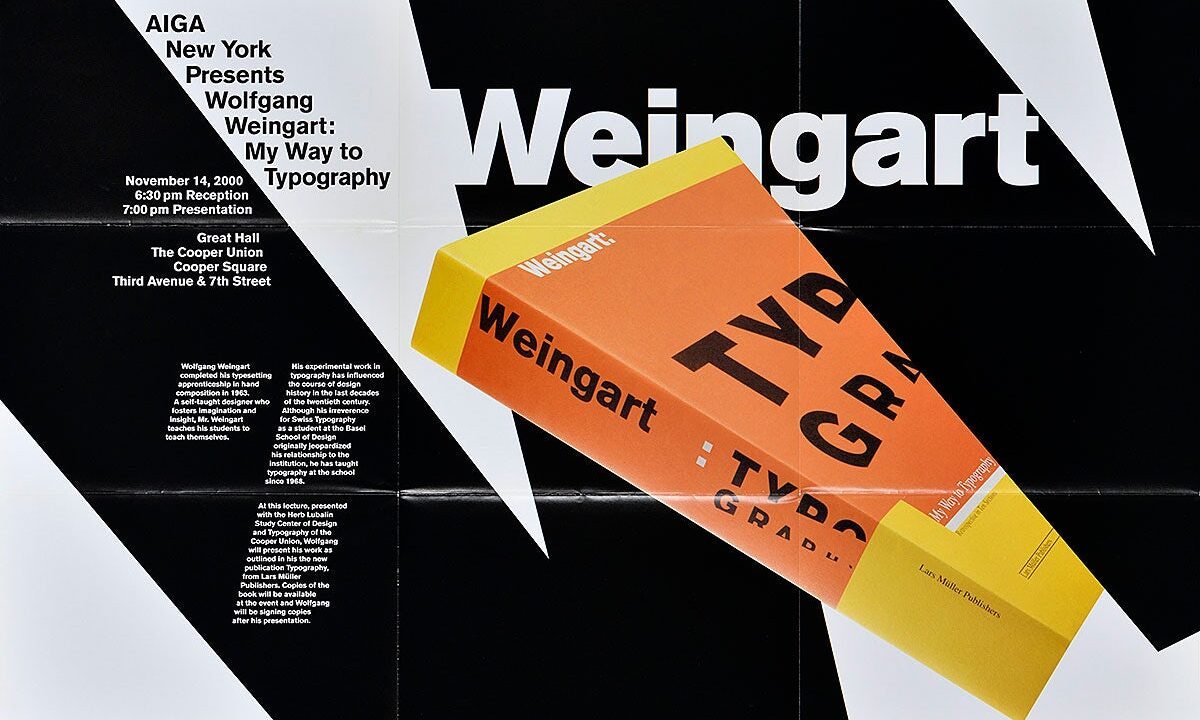
Spanning roughly 50 years of events, exhibitions and talks, the archive is a vital record of a creative community responding, in real time, to the rhythms, tensions and collisions that define New York. Seen together, the posters shed light on how graphic design has both shaped and mirrored the city’s evolving cultural identity.

The decision to revisit the archive was sparked by AIGA NY’s recent rebrand, which launched in December and was created by native New Yorker Christopher Guerrero with support from former AIGA NY board member Raven Mo. The new identity – a flexible, typographically driven system – prompted the organisation to look backwards, digging into its origins as a hub for New York design, while also clarifying visual themes and common threads across generations of volunteers and board members.
For AIGA NY’s executive director, Stacey Panousopoulos, one of the biggest surprises was not how much the work had changed, but how much it hadn’t. “When seeing the full scope of the archive, we were surprised by the consistency of the Chapter’s voice throughout the decades,” she says. “It’s amazing to see that our board members have always had a focus on questioning, exploration and celebration of design.” Despite dramatic shifts in tools, technologies and trends, the posters share an underlying confidence and curiosity that feels distinctly New York.
That consistency is inseparable from AIGA’s role within the city. Beyond documenting the work of individual designers, the archive is evidence of a highly engaged local community. Posters advertise public-facing events, but they also reflect a commitment to making design tangible and local – from collaborating with New York printers and paper suppliers to treating posters as objects worth keeping. Many of the pieces have been collected by members over the years, accruing personal stories alongside their graphic impact.
Interestingly, there is no single ‘New York style’ on display – and that is precisely the point. “The beauty of designing for New York creatives is the seemingly non-existent guard rails,” Panousopoulos says. Down the years, type has been mixed, stretched, distressed, scaled up and smashed together. Old rubs up against new everywhere you look. It reflects a city where multiple narratives coexist, and where friction often leads to creative breakthroughs.

At times, the posters do more than document design culture, they anticipate broader social and political shifts. Panousopoulos points to the Hell Yes event poster, created around the 2004 US election, as a particularly telling example. Using illustration and a comic-strip format, the poster moved beyond promotion into critique and civic engagement. Looking back, it feels like an early signal of how graphic design would increasingly be used as a tool for questioning power and participating in public discourse – a role that has since become central to contemporary visual culture.
This is where the archive’s significance extends beyond design history – it brings into sharp focus what issues mattered to the creative community at specific moments in time. As Panousopoulos notes, design functions as a time capsule: “An archive like ours attempts to capture snapshots and stories of brief moments of life in NYC – what issues were important to our community? How did we communicate with each other?”
Those questions continue to inform AIGA NY’s work today. Its current output, produced by an all-volunteer board, is consciously shaped by what has come before, while staying tuned in to the present moment. Putting community first while maintaining authenticity in a city quick to call out phoniness remains central to AIGA’s aims. The archive, in this sense, is not a closed book but a living, ever-expanding reference point.
Looking ahead, Panousopoulos has ambitious plans for the collection. She’s working towards making the archive physically accessible, alongside developing a book that will showcase the posters in greater depth. As the material opens up to designers, students and the wider public, the hope is that it will reveal something fundamental about both design and the city itself. Above all, she says, the hope is that “folks come away with an understanding that New York’s design community has always been active in social and civic discourse”.
[ad_2]
Source link