[ad_1]
From May 16 to June 4, 2026, Salamon Fine Art gallery in Milan is hosting Fabio Adani’s solo exhibition Silentium fin che parli. A journey between painting, graphite and the written word that investigates the perceptual transformation of reality through the language of allusion.
The Salamon Fine Art gallery in Milan, from May 16 to June 4, 2026, is hosting the exhibition Silentium fin che parli, a solo show by Fabio Adani (Correggio, 1974) that presents itself as an investigation into the nature of visual language and the ability of the image to transform itself through perceptual, symbolic and material processes. The exhibition, which can be visited Monday through Friday from 3 to 7 p.m. or by appointment at Via San Damiano 2, develops as a path that relates painting, drawing and the written word within a research that privileges the allusive dimension over direct representation.
The project, with a critical text by Beatrice Gardella, accompanied by prose and poetry texts by Elisabetta Amaini, is based on the idea thatallusion is a rhetorical figure capable of activating unexpected cross-references, where what is observed does not remain stable but changes through the intervention of the imagination. In this perspective, vision is never a neutral act but a process in which perception is constructed by addition and subtraction, involving a plurality of sensory factors that go beyond the centrality of the gaze to extend to the overall dimension of experience.
The exhibition proposes work that develops along an unstable perceptual threshold, in which visual language does not merely describe reality but accompanies its transformation. Adani constructs a system of images that does not tend toward conclusive definition but toward the continual mutation of its meanings, allowing meaning to emerge as the result of an open-ended and non-predetermined process. In this context, the very title Silentium fin che parli suggests a curious, oxymoronic tension between silence and speech, between suspension and activation of language.
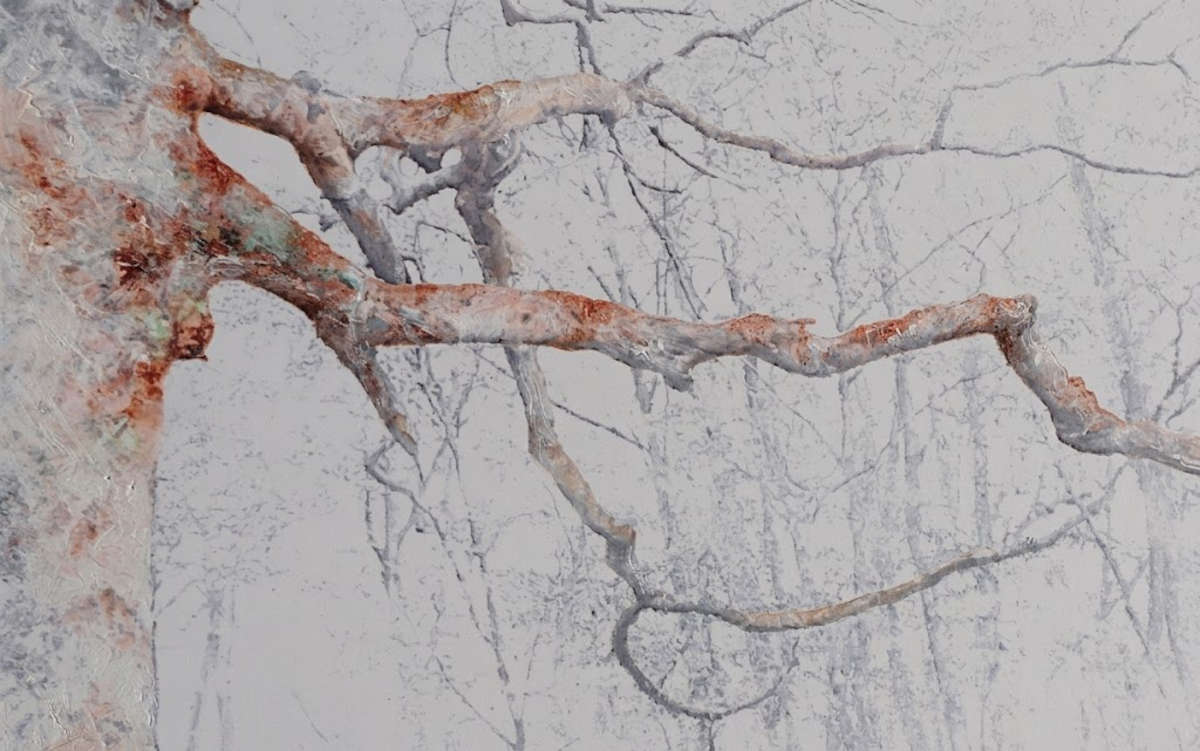
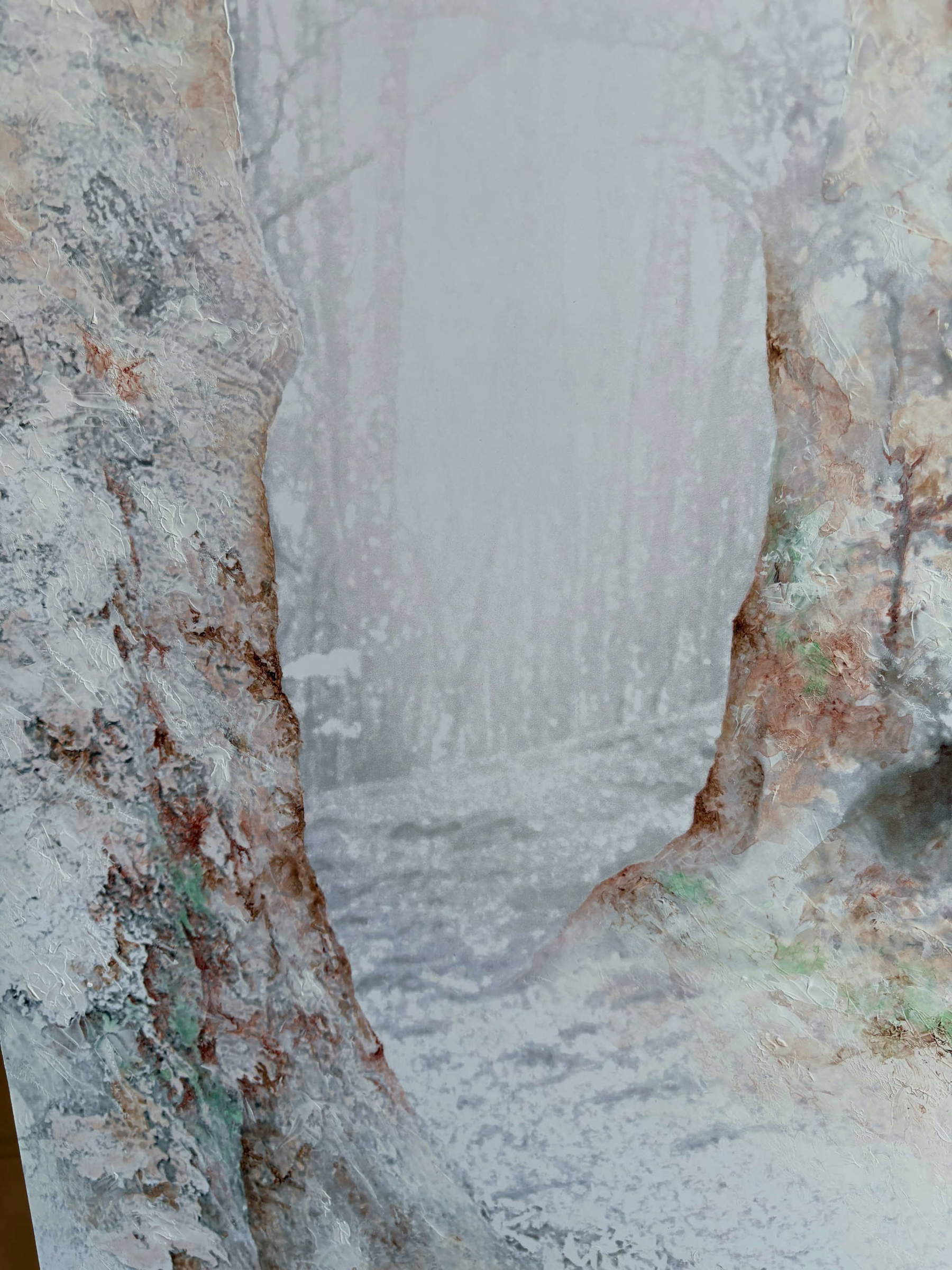
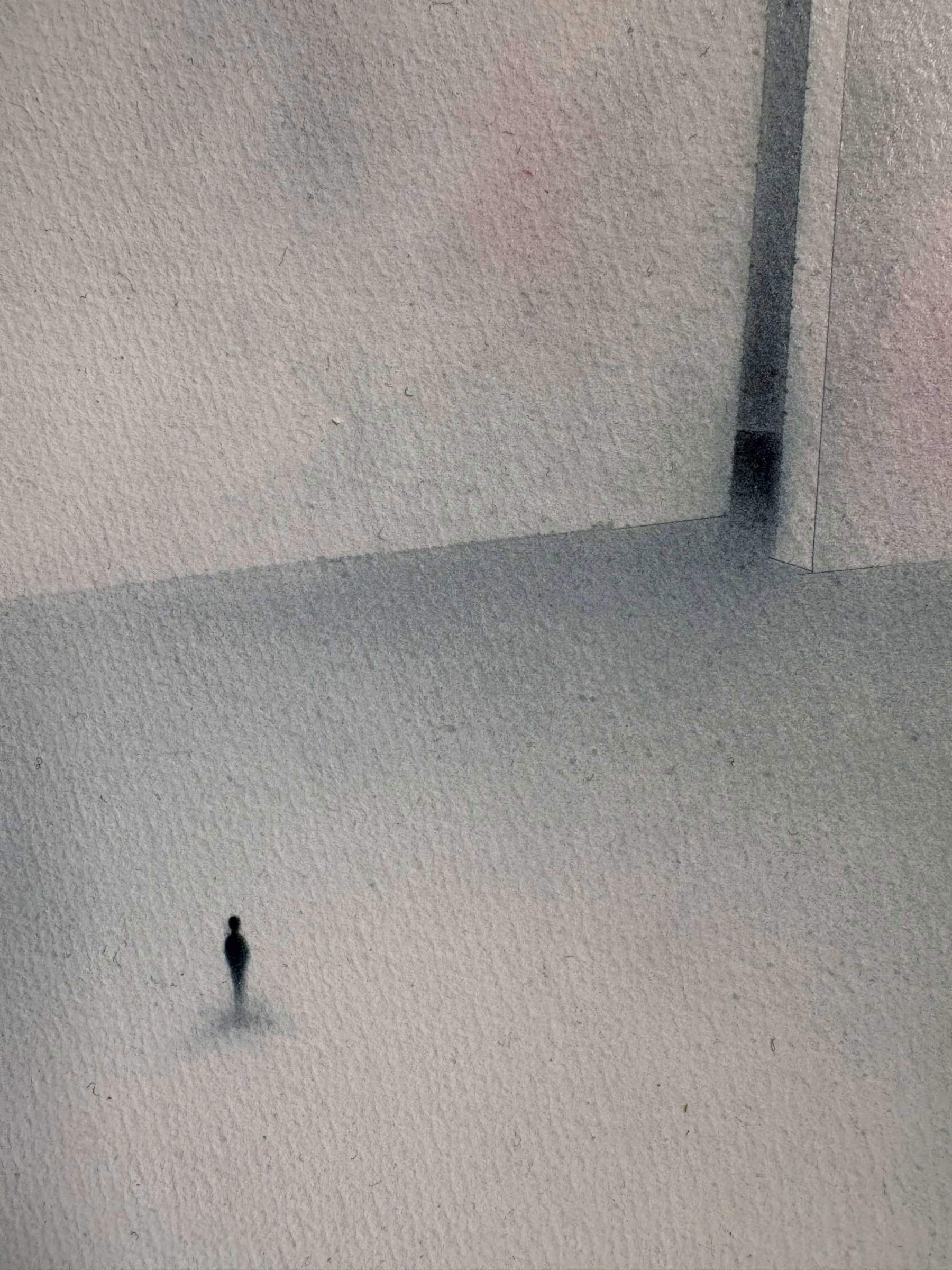
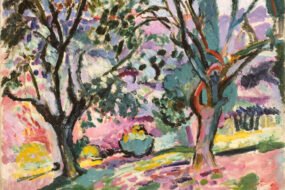
The exhibition focuses on a series of works that take shape from natural environments, particularly from a wooded dimension that becomes mental as well as physical space. The artist accompanies the viewer along a landscape that is not presented as a simple representation of the natural, but as a complex organism in which each element refers to something else. Tree trunks, with their irregular surfaces and material articulations, are never just what they appear to be, but becomesymbolic structures open to multiple interpretations. In this dynamic, the branch can thus evoke the flight of a bird, while the trunk of a tree can recall the architectural solidity of a sacred structure. A barely noticeable path is thus transformed into a theatrical scene, into a performance space that no longer belongs exclusively to nature but to the imaginative construction of the viewer. The exhibition insists on this capacity of the image to generate further levels of meaning, making it clear that perception is always an act of interpretation.
Fabio Adani’s poetics is thus developed as an invitation to slow the gaze and suspend the immediate act of recognition. To access this level of reading requires, according to the conceptual framework of the exhibition, a form of predisposition that allows one to abandon the desire for definition in order to welcome the continuous transformation of forms. It is not simply a matter of traversing the represented landscape, but of participating in its very constitution, assuming a position within the system of relationships that compose it.
The visual language used by Adani is articulated through a combination of different media, including graphite, acrylic and the written word, which are integrated with the practice of watercolor. The latter, by its nature evanescent and fluid, becomes the privileged place where the pictorial matter can dissolve or strengthen depending on the degree of adherence to the represented reality. The layering of materials contributes to an unstable surface, in which form is never final but always subject to variation.
Embedded within this process is an almost alchemical dimension of transformation, in which the pictorial material seems to pass through different states without ever fixing itself in a conclusive configuration. The artist’s research extends to the inclusion of gold leaf, an element traditionally associated with transcendence and the spiritual dimension of the image. In this context, the precious metal does not assume a decorative role, but becomes an integral part of a process of transformation of the material, which is treated as a living organism capable of generating new forms of light and meaning.
The exhibition Silentium fin che parli thus develops as an investigation of the threshold between what appears and what is evoked, between what is recognizable and what escapes immediate definition. The artist’s work is located in an intermediate space, in which reality is not represented directly but traversed by a network of associations that continually alter its perception. The entire exhibition project is thus configured as an invitation to consider vision not as an act of immediate consumption of the image, but as a slow and layered process in which meaning is constructed over time through the relationship between perception, memory and imagination.
|
| Fabio Adani investigates the perception of reality in his exhibition at Salamon Fine Art |

Warning: the translation into English of the original Italian article was created using automatic tools.
We undertake to review all articles, but we do not guarantee the total absence of inaccuracies in the translation due to the program. You can
find the original by clicking on the ITA button. If you find any mistake,please contact us.
[ad_2]
Source link