[ad_1]

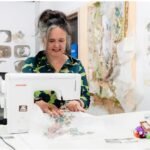
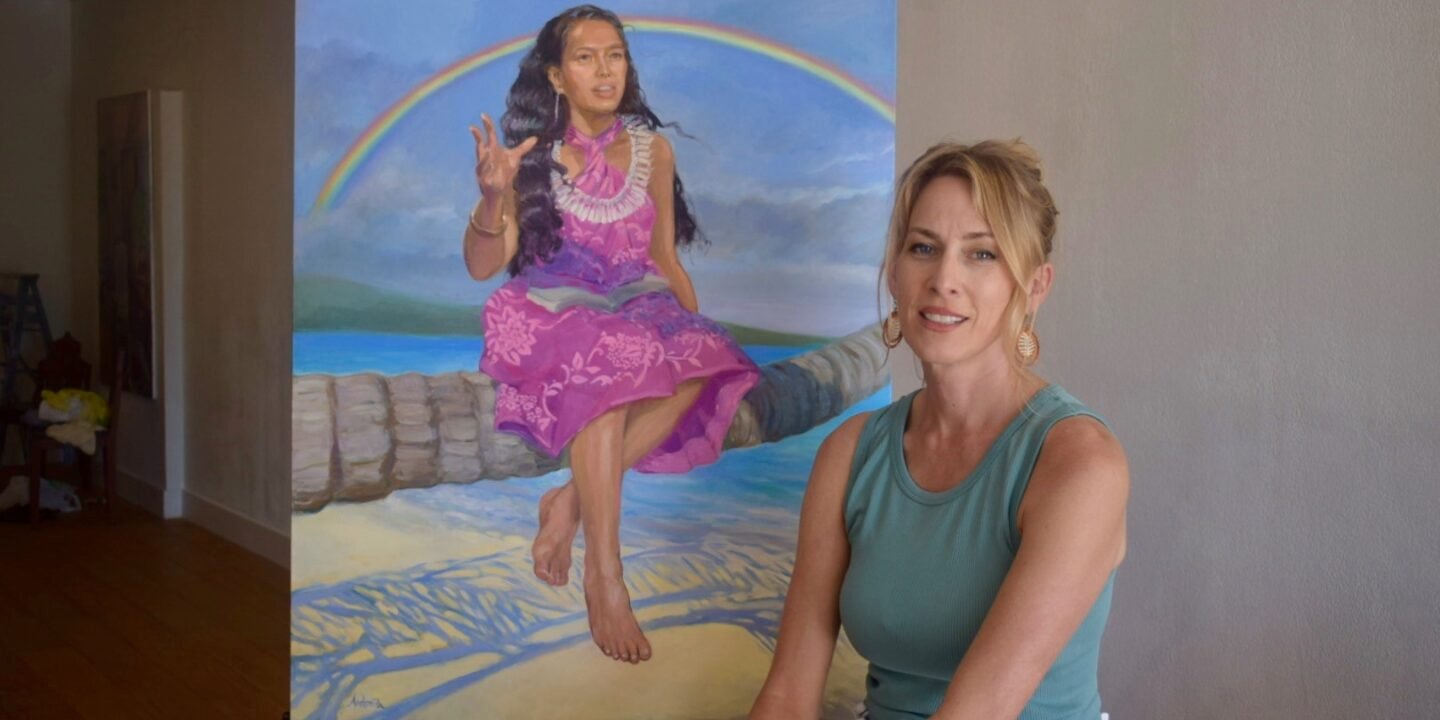
Southwest Florida artist Antonia Crook with her painting Haunani-Kay Trask, a native Hawaiian activist, educator, author and poet. -COURTESY PHOTO
Art: We often look at a beautiful piece and feel something inside of us, maybe an emotion. It could be sadness, confusion, anger or joy. The true art behind a painting, drawing or photo is the emotional tie you create between your viewer and the piece.
It’s a sunny day on Sanibel Island, the paint is still wet, and canvases line the walls. A woman, filled with endless ideas and the worries of this life cast aside, continues to paint. The brush strokes a blank canvas, and the image slowly comes to life. A woman adorned in purple sits upon a palm tree branch, a beautiful rainbow behind her, with the sand of the beach beneath her feet. Her image will soon be traveling over 4,000 miles across the Pacific Ocean. Who is she, and why does any of this matter?
Meet Antonia Crook, a woman not defined by the troubles she’s faced, but rather by her ability to live in the moment and let the beauty of the natural world inspire her work. Crook has been painting and creating art for as long as she can remember. Life has taken her on a journey, from working as a teacher at the Art Institute of Austin to drilling down with individuals on a more personal level as a mental health counselor and eventually opening her own art studio. She’s seen her fair share of hardship and triumph.
“I had been painting every day of my life up until about 2020, then, like a lot of people, I lost my job during COVID,” said Crook. “It was around then that I thought to not worry about art anymore because that changed everything for me.”
Crook then decided to seek a career that offered her a bit more stability. Not too long after being let go as an art instructor, she began as a mental health counselor. Although she was no longer an art teacher, she would continue to incorporate her talents into her work in the form of art therapy sessions. As time went on, Crook would lose her creative fire, but that flame wouldn’t stay out for long. After Hurricane Irma, Crook reached out to a friend in the Sanibel area to see how things were going.

Haunani-Kay Trask, an impactful Hawaiian activist, painted by Southwest Florida local Antonia Crook. -COURTESY PHOTO
“After we got back in touch and finally met up, he, of course, asked how my art was going,” said Crook. “We would end up restarting our relationship, and I moved back to Florida. I loved painting the palm trees and wetlands when I used to live here; moving back gave me the huge urge to paint again.”
Fast forward to April 1 of this year, and Crook, along with her partner, is now the proud owner of Atelier Antonio Art Studio, located on Sanibel Island.
“When I moved back here, it was in the back of my mind that I wanted to have my own gallery and studio,” said Crook. “Every artist at some point wants their own studio, and it never seems real until you’re there.”
Leading up to the start of Atelier Antonio, Crook began work on something special. Inspired by the life of Haunani-Kay Trask, a native Hawaiian activist, educator, author and poet, she wanted to create a piece that encompassed her life. Painted from her point of view, the piece captures the life she led, the emotions she felt, and the peace she desired to bring to the Hawaiian Islands.
“I need meaning behind my paintings,” said Crook. “If you go to Hawaii, you’re gonna see a rainbow; I also put a book on her lap because she was an author; she was always reading. Where else are you going to see a beautiful Hawaiian woman on the beach with a book? I wanted this to be about her, from her point of view.”
After she completed the piece, she connected with a woman at Big Arts on Sanibel Island who formerly worked for the King Kamehameha V Judiciary History Center in Hawaii, and things were slowly falling into place.
“I learned of Antonia’s painting of the late Haunani-Kay Trask through my friend and former coworker Elizabeth Gromko (Development Director, BIG Arts),” said Brieanah Gouveia, curator of collections and programs. “She reached out to me because Antonia was looking to gift her painting to an organization in Hawaiʻi, Haunani-Kay’s home and ancestral land. I was struck by Antonia’s depiction of Haunani-Kay, mid-speech, sitting on a coconut palm tree with an open book in her lap, haloed by a rainbow on a serene beachfront landscape.”
Crook later agreed to donate her piece to the exhibit; she felt thrilled and honored that they would want to display her work. The Judiciary history center incorporates art into its exhibits so visitors can reflect on Hawaii’s complex past and current issues, fostering critical thinking and visual literacy. Using art pieces like Crook’s portrayal of Haunani-Kay aids in visual representations of history, helping those eager to learn make connections to the history they are reading about.
“I’ve gone to museums as a kid and remember thinking that it would be a dream of mine to have my art somewhere that others could see,” said Crook. “I can’t imagine a better place for it to go; this is such an honor.”

The Judiciary History Center in Hawaii, where Antonia Crook’s art piece will be displayed. -COURTESY PHOTO
At one point in time, Crook thought about putting her paintbrushes away for a while, but now she has an opportunity to represent her community on a beautiful island more than 4,000 miles away. Crook’s story is bigger than just this piece; it can serve as an inspiration for struggling artists alike who can’t see the way forward.
“You can’t put stuff off, you know?” said Crook. “I said, ‘Okay, let’s just do this. I’ll be an artist. Like, let’s go. I’m going to just try.’”
Crook’s philosophy? Just give it a shot. She says the only way you’re going to get better is by not being afraid to make something ugly; art isn’t always pretty.
Crook’s piece will sit alongside a wide array of historic exhibits dedicated to promoting the interests and civic empowerment of Native Hawaiians and the general public.
“I want people to know that when I paint a person, I really care about that person,” said Crook. “Every single human that I paint represents something that truly matters. When I’m painting a person’s portrait, I want to capture their spirit and their energy. So, I’m not just painting for pretty designs; I’m painting because I’m trying to tell a story.”
To learn more about the Judiciary History Center and its mission, you can visit www.jhchawaii.org.
[ad_2]
Source link