[ad_1]
What does the average Drake University student picture when they hear the word “printmaking”? If they’re not an art major, maybe they don’t think of anything at all. But any run-of-the-mill definitions are left behind at the Anderson Gallery’s latest exhibit.
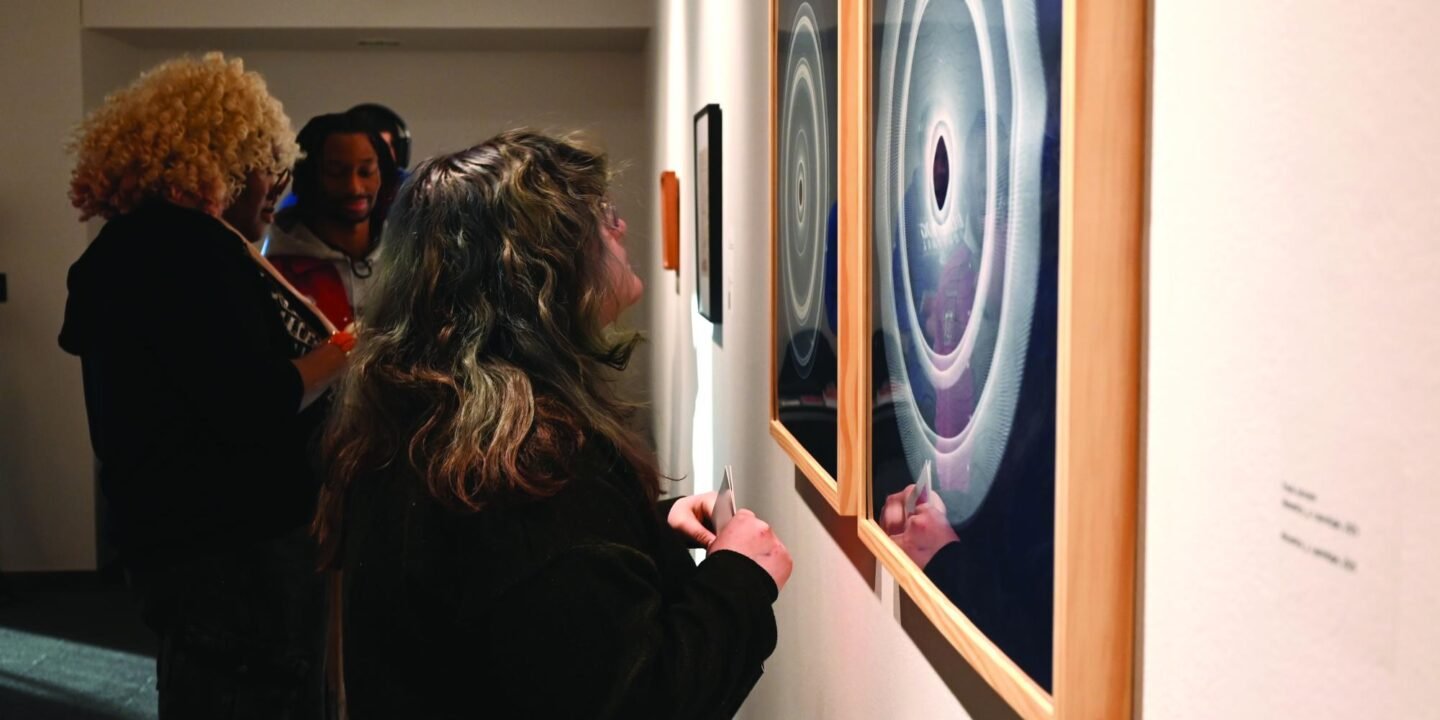
Drake’s Anderson Gallery held an opening for its inaugural Richard Black International Juried Print Exhibition, titled “Transformative Impressions,” on Feb. 5 from 5 to 7 p.m.
Raluca Iancu, an associate professor of printmaking at Iowa State University, was one of the exhibit’s two jurors. She described the exhibit as a reflection of “the expansive ways printmaking is being redefined today, not only as a set of historical techniques, but as a flexible, conceptually driven mode of inquiry.”
Jurors Iancu and Sang Lee — an associate professor of graphic design at Drake — said that artists like Chicago-based printmaker Cal Froikin were chosen for their innovative approaches to the established medium. Froikin said his work is “very process-driven” and often resamples “old imagery that [he’s] created over the years.”
“When I was introduced to the medium, there was a lot of focus on tight registration and composing an image in a more deliberate […] way,” Froikin said. “But for my personal practice […] it’s really about exploration and playfulness.”
Iancu and Lee received 120 submissions from the U.S. and abroad. 37 works made it into the final show, and with 23 different print artists featured, no two works were the same.
“Western Horizon #1,” a piece by Rhode Island-based Ben Anderson, extends off the wall, forming a fishing boat made from carefully cut woodblock prints. The curves of the print match the delicate folds of the beige paper, which resembles worn wooden slats.
“It all changes in a moment,” by Seattle-based Erika Adams, cut two prints and weaved them together, forming an almost psychedelic pattern. The resulting image is reminiscent of post-Impressionist painter Georges Seurat’s “A Sunday Afternoon on the Island,” with a kaleidoscope of textures that become unreadable up close, but form a cohesive image when looked at from afar.
“I really love the variety in this show; it says to me that anything is possible with print,” said Iowa-based Mary Jones. Jones said her two works on display, “Crosswalk” and “Flaneuse,” are inspired by her love of walking and “the things she collects along the way.”
Jones’s work is collaged, featuring figures walking, playing and staring contemplatively into the distance. These figures are set against the backdrop of city streets that range in detail, with parts looking like architectural blueprints and others that evoke the image of a schoolhouse reading rug. In her artist statement, Jones wrote that the work is meant to “consider the shape of the walk and how it shapes [her], [her] memories and desires.”
The exhibition’s namesake, Richard Black, was a printmaking professor at Drake from 1960 until his retirement in 1994. In 1974, he founded the Drake University Biennial Print Symposium, which presented print work by American and international artists as a recurring exhibit until 1991.
When Black died in 2020, he left an endowment to Drake’s art and design department intended to fund exhibits of print work. Anderson Gallery Director Lilah Anderson said the gallery committee thought this exhibit would be a good tribute to Black.
The committee was intentional about structuring “Transformative Impressions” similarly to his biennial symposia, with international submissions showcasing a variety of approaches, Anderson said.
Although the exhibition emphasized contemporary methods, many of the works still have the foundation of traditional practice, Iancu said.
“That speaks to the endurance of this medium,” Iancu said. “We can create really strong contemporary works while still using our craft heritage […] it can all coexist together.”
The exhibit features small black and white two-dimensional prints like Iowa-based Craig Volesku’s “Vintage Woman 1” alongside colorful, wall-filling works like Kansas City-based Miguel Rivera’s “Della Salute III,” a large multimedia work that is five feet tall and over nine feet long.
Rivera’s work — which is so large that viewers have to take a few steps back to see it in its entirety — won the Juror’s Choice Award, which was presented at 6 p.m. by Drake’s College of Arts and Sciences Dean Gesine Gerhard, along with four honorable mentions.
Exhibitions like these expose art and design students to new ideas and offer them a glimpse into their future as professional artists, Jones said, recalling her own university experience.
“It was a combination of works in the [university] museum and visiting artists […] where I got excited about making art and where I figured out that it was possible to turn it into a career,” Jones said.
The reach of the exhibit went beyond just the art and design department, including non-art majors like first-year Erin Koller, who attended to support her friend working at the gallery.
“I really like looking at art and trying to see […] what I think the artist meant,” Koller said. “It’s engaged my artistic side [by] having to look into an artist’s perspective.”
Gallery runners marked the opening a success with over 100 attendees at the event throughout the evening.
“At least for art and design, this space serves as a real meeting place and community gathering space,” Anderson said.
“Transformative Impressions” will remain on display until March 13. Looking ahead, Anderson said the gallery committee plans to hold more juried print exhibits, though they likely won’t occur every year.
Anderson Gallery’s next exhibit will be the 55th Annual Juried Student Exhibition, opening on March 29. Submissions are open until Feb. 20, and any Drake student who was enrolled in an art and design course within the past two years can submit work.

[ad_2]
Source link